Prospecting
Strategic Guide to Multichannel Prospecting (2026)
// Short answer
Multichannel prospecting is a sales strategy that combines several touchpoints (email, LinkedIn, calls, WhatsApp, social networks, sometimes SMS) to engage your prospects at the right time, with the right message and on the right medium. It is not just a sum of channels: each interaction prepares the next, which increases response rates and speeds up the sales cycle.
By Benedicte Rivory
16 min read
There are those who wait for the phone to ring… …and those who start the conversation before anyone else.
In an environment where inboxes overflow, social networks are saturated and prospects become hard to reach, one thing is certain: a single channel is no longer enough.
Sales cycles are getting longer, competition is intensifying, and decision-makers filter everything.
The companies that perform today have one thing in common: they orchestrate their approaches with precision, like a military campaign. Each channel reinforces the others, each contact is thought through, each message is optimized. This is the strategy that turns a simple contact into a qualified meeting, and a meeting into a customer.
Welcome to the era in which B2B sales teams are reinventing B2B prospecting to stay visible, relevant and impossible to ignore.
1. What is multichannel prospecting?
💡 Multichannel prospecting is a sales strategy that combines several touchpoints to engage your prospects at the right time, with the right message and on the right medium. Rather than betting on a single channel, B2B teams orchestrate a seamless journey across email, LinkedIn, phone calls, WhatsApp, virtual events, and sometimes even SMS.
The goal: maximize the chances of getting a reply and starting a conversation with increasingly solicited decision-makers.
It is not just a sum of channels. It is a coordinated approach in which each interaction feeds the next. An email can prepare a call, a comment on LinkedIn can open the door to a private message, and a webinar can build the credibility needed to convert.
In a B2B context, multichannel prospecting lets you:
Increase response rates through controlled repetition of touchpoints
Reach decision-makers where they are active rather than waiting for them to come to you
Speed up the sales cycle by creating personalized, automated sequences
Improve the relevance of conversations by adapting tone, format and timing to each channel
In 2025, teams that limit themselves to a single channel are condemned to fly under the radar. Prospects expect a more human, proactive and contextualized approach. Multichannel prospecting is the answer.
2. The main channels of B2B multichannel prospecting
The strength of multichannel prospecting does not come only from the variety of channels used, but from how they fit together. Each touchpoint has a specific role in the overall strategy: grab attention, generate interest, spark a conversation, then convert.
Some channels are used to initiate first contact, others to follow up or close. Effectiveness relies on smartly combining several levers, based on prospect profiles, their communication habits and the type of offer.
Channel | Role in multichannel prospecting |
|---|---|
An essential channel to initiate contact, share personalized content and schedule automated sequences. | |
Ideal for identifying decision-makers, starting conversations and building credibility through content creation. | |
WhatsApp and messaging apps | Make conversations more human, get quick replies and speed up meeting booking. |
Powerful for creating direct contact and quickly qualifying the prospect's interest. | |
Complementary social networks | X, Facebook Groups or other communities let you reach prospects where they get informed and exchange. They are rarely used, but they increase visibility over the very long term. |
👉 Each channel has its strengths, limits and specific uses. To build a truly effective strategy, you need to understand how to use them together rather than in isolation.
Cold email, the pillar of multichannel prospecting!
Cold email remains one of the most powerful B2B channels for making first contact. It lets you target, personalize and automate your messages at scale. But effectiveness does not depend on the volume sent: everything relies on the relevance and quality of the approach.
Competition in inboxes is fierce. Every day, your prospects receive dozens of sales emails. To stand out, you need to be clear, human and precise.
Best practices to maximize your results
Personalize each message → mention the name, job title, company and a specific detail about the prospect
Craft your subject line → short, engaging, sparking curiosity without falling into clickbait
Segment your databases → a generic message sent to everyone does not convert
Automate without dehumanizing → the right tools, like Scalability, let you create dynamic multichannel sequences
Track the essential KPIs → open rate, click rate, positive replies and conversions
An email alone is no longer enough, but it remains the ideal starting point to capture attention and prepare the other touchpoints: LinkedIn, calls or WhatsApp.
LinkedIn, the essential B2B lever
LinkedIn is much more than a social network: it is a living database of decision-makers, prospects and partners. In B2B, it is one of the best-performing channels for creating quality touchpoints, starting strategic conversations and strengthening your company's credibility.
Unlike email, LinkedIn lets you combine visibility, engagement and direct interaction. A good profile, relevant content and personalized approaches can turn your network into a real lead generation engine. But be careful: generic messages and poorly calibrated automated sequences no longer work.
Best practices for using LinkedIn
Optimize your profile → take care of your photo, headline and summary to reflect your expertise and inspire trust
Identify the right prospects → use advanced filters, Sales Navigator or CRM integration to target the right decision-makers
Alternate content and prospecting → post regularly to gain visibility, then engage the most responsive prospects by private message
Personalize messages → avoid standardized approaches, mention a post, a project or something in common to capture attention
Combine LinkedIn with other channels → a comment can prepare an email, a post can lead to a meeting, a conversation can kick off a call
LinkedIn reaches its full potential when it is part of a multichannel sequence. Used well, it does more than generate leads: it builds authority and paves the way for conversions.
WhatsApp and instant messaging to speed up conversion
WhatsApp, Messenger and Telegram are taking a growing place in B2B prospecting. Where email initiates contact, instant messaging makes conversations more human and gets quick replies. This channel creates a more direct relationship and makes booking meetings easier.
Effectiveness relies on personalization and good timing. Misused, it can quickly be seen as intrusive, or even as spam.
Best practices for using WhatsApp in B2B prospecting
Get consent → favor prospects who have already interacted with you
Personalize messages → a natural, human tone adapted to the context
Sync WhatsApp with your CRM → centralize conversations in a tool like Scalability
Keep it short → short, engaging messages are more likely to get a reply
Combine with other channels → a WhatsApp message can follow an email or prepare a call
Well integrated, this channel speeds up prospect qualification and strengthens the sales relationship. WhatsApp also lets you do lead nurturing and stay in closer contact with hot prospects.
Cold calling to create direct, qualified contact
Despite the rise of digital, cold calling remains a remarkably effective channel in B2B prospecting. Making a call creates an immediate human connection, quickly qualifies the prospect's interest and gets information that no email can provide.
Used well, it is a lever that speeds up sales cycles. Poorly prepared, it causes rejection. The secret: target the right prospects, prepare your approach and integrate the call into a coherent multichannel sequence.
Best practices to optimize your calls
Prepare a flexible script → have a clear structure while leaving room for improvisation
Qualify before calling → check the profile, needs and context via LinkedIn or your CRM
Personalize the introduction → mention something in common, an event or a challenge the prospect faces
Anticipate objections → prepare short, solution-oriented answers
Chain with other channels → a call can be preceded by an email or followed by a LinkedIn message to increase impact
Cold calling is more powerful when it is part of an overall strategy: it captures attention, creates closeness and opens the door to conversions.
Prospecting on complementary social networks to diversify touchpoints
Beyond LinkedIn, other platforms like X (formerly Twitter), Facebook Groups or even Reddit offer opportunities to prospect on social networks and reach specific audiences. These channels let you interact with your prospects in a more informal environment, where they share their challenges, look for solutions or talk with their peers.
Their strength lies in creating authentic conversations. Used well, these networks complement emails, calls and WhatsApp to strengthen your visibility and multiply touchpoints.
Best practices for effective prospecting
Identify active communities → Facebook groups, specialized forums or X threads where your prospects actually talk
Share relevant content → publish or comment on posts that bring real value to your audience
Watch for buying signals → spot discussions where prospects express concrete needs
Join the conversation → favor natural, non-sales messages to engage gradually
Integrate these channels into your sequence → use a comment, a DM or a like to prepare an email or a call
Important: prospecting on social networks does not replace the main channels, it complements them. It is an ideal lever to engage subtly, build trust and generate qualified conversations.
3 ready-to-use B2B multichannel sequences!
Sequence 1: Re-engage a cold lead after a demo
👉 You ran a demo, the prospect seemed interested… then radio silence. The goal of this sequence: warm up the relationship and bring the prospect back into the loop.
Sequence flow
Day 1 → Follow-up email with a summary of the demo and a reminder of the key benefits
Day 3 → Personalized LinkedIn message to restart the conversation
Day 5 → Email with a relevant case study or customer testimonial
Day 7 → Quick WhatsApp message to address any objections
Day 10 → Final email with a clear CTA: schedule a call or confirm lack of interest
Sequence 2: Target a new strategic account
👉 The goal is to break into a priority target account and capture decision-makers' attention by multiplying touchpoints. This sequence aims to establish credibility and open the door to a meeting.
Sequence flow
Day 1 → Personalized introduction email with a specific insight about the company
Day 2 → Connect with the decision-maker on LinkedIn + contextual opening message
Day 4 → Send premium content (study, report, white paper) by email
Day 6 → Additional LinkedIn message or InMail to restart the discussion
Day 8 → Targeted call to propose a quick conversation
Day 12 → Final recap email with a strong CTA to set a meeting
Sequence 3: Re-engage a prospect who has been inactive for several months
👉 A prospect showed interest in the past but has gone silent. This sequence helps re-engage the contact by bringing new value.
Sequence flow
Day 1 → Reactivation email with a personalized hook
Day 3 → Share recent content: study, report or new product
Day 6 → LinkedIn message to reconnect informally
Day 9 → Email with an exclusive offer or a clear benefit
Day 12 → Final call or WhatsApp to propose a quick conversation
The 8 best multichannel prospecting tools in 2025!
The three best multichannel prospecting tools in 2025 are:
Tool | Strengths | Starting price |
|---|---|---|
Multichannel prospecting, advanced automation, sequence orchestration, CRM integration, AI and centralized tracking. | On request | |
Multichannel automation (email, LinkedIn, calls), personalization, built-in lead database. | From $69/user/month (Email Pro); $99/user/month (Multichannel Expert) | |
Sales engagement, multichannel sequences, advanced analytics and solid CRM integrations. | Custom quote | |
Sales execution platform with automation, AI features, analytics and integrations. | Custom quote | |
Extensive B2B database, advanced filters, sequence automation, analytics. | From $49/user/month | |
B2B contact enrichment and verification, CRM integrations, enrichment API. | From $37.45/user/month | |
Advanced prospect search, filters, CRM sync, activity tracking. | From $99.99/user/month (Core) | |
CRM + prospecting tools combined, sales-oriented automation. | From $20/user/month |
1. Scalability
Rating ⭐⭐⭐⭐⭐ (42 reviews)
Scalability centralizes all B2B prospecting management on a single platform. The tool lets you create, automate and personalize multichannel sequences that include emails, LinkedIn, calls, WhatsApp and SMS. Its AI engine optimizes each interaction to maximize response and conversion rates. Unlike most tools, Scalability does not just send messages: it orchestrates the strategy end to end.
✔️ Advantages
Full automation of multichannel sequences
Native CRM integration and real-time sync
Built-in AI to analyze data and personalize messages
Centralized lead management, performance tracking and advanced reporting
Ideal for sales teams as well as growing solopreneurs
❌ Limits
No free version
A slight learning curve to take advantage of all the features
Pricing
Scalability pricing is available on request. Rates are adapted to team size and prospecting volume, which allows a flexible, tailored offer.
2. lemlist
Rating ⭐⭐⭐⭐ (280 reviews)
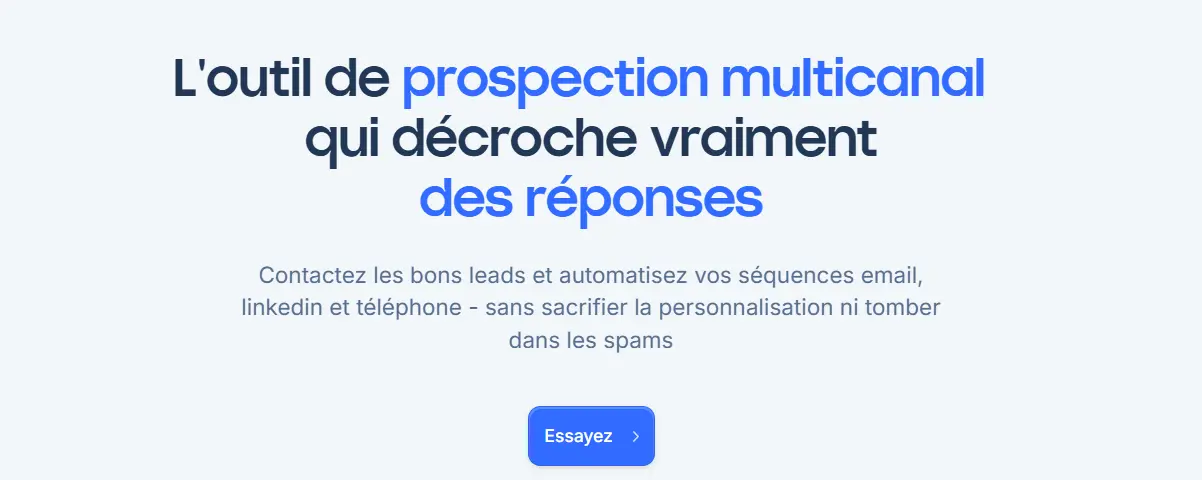
lemlist is a B2B prospecting platform dedicated to automating and personalizing campaigns. It lets you manage multichannel sequences (emails, LinkedIn, calls), improve deliverability with lemwarm, enrich prospect data and track performance.
✔️ Advantages
Highly customizable messages (text, images, dynamic variables)
Multichannel sequences combining email, LinkedIn and calls
Better deliverability through lemwarm
Built-in lead database and automatic enrichment
Smooth CRM integrations and many automations
❌ Limits
Limited enrichment credits
A slight learning curve on some features
Pricing
Email Pro → $69/month
Multichannel Expert → $99/month
Enterprise → custom quote
3. Salesloft
Rating ⭐⭐⭐⭐ (4,155 reviews)
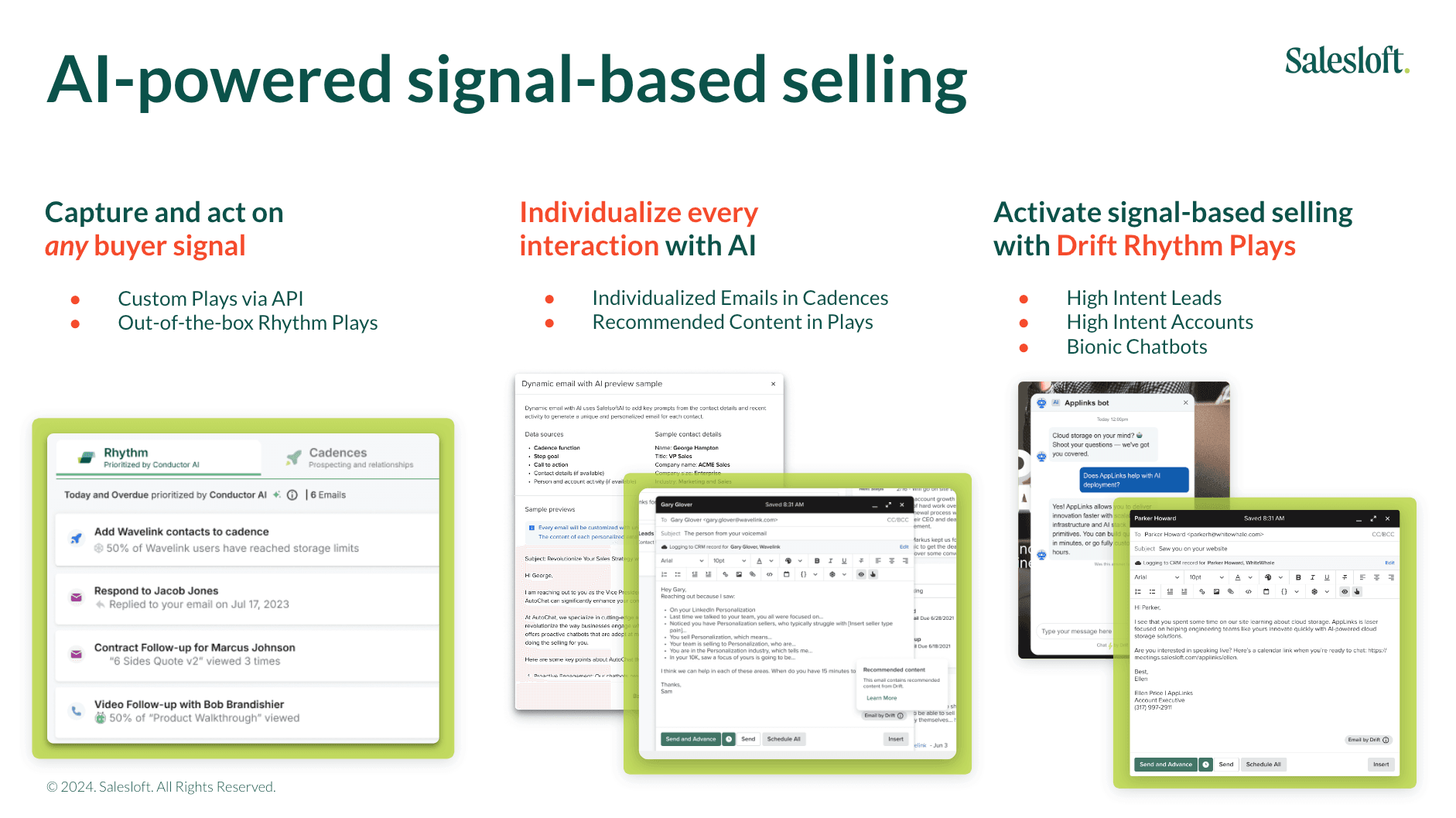
Salesloft is a powerful solution for B2B sales teams looking to structure and automate their multichannel prospecting. The tool centralizes email sequences, calls, LinkedIn and task reminders, and provides detailed analytics to track every interaction precisely.
✔️ Advantages
Multichannel sequence management in a single interface
Advanced analytics to track conversions and optimize approaches
Native integrations with the main CRMs (Salesforce, HubSpot, Pipedrive…)
Automation of repetitive tasks and smart reminders
Ideal for structured sales teams
❌ Limits
High pricing for small teams
Longer learning curve than other tools
Interface considered dense by new users
Often requires a fairly extensive initial setup
Pricing
Essentials → from about $125/user/month
Advanced → about $165/user/month
Enterprise → custom quote
4. Outreach AI
Rating ⭐⭐⭐⭐ (3,496 reviews)
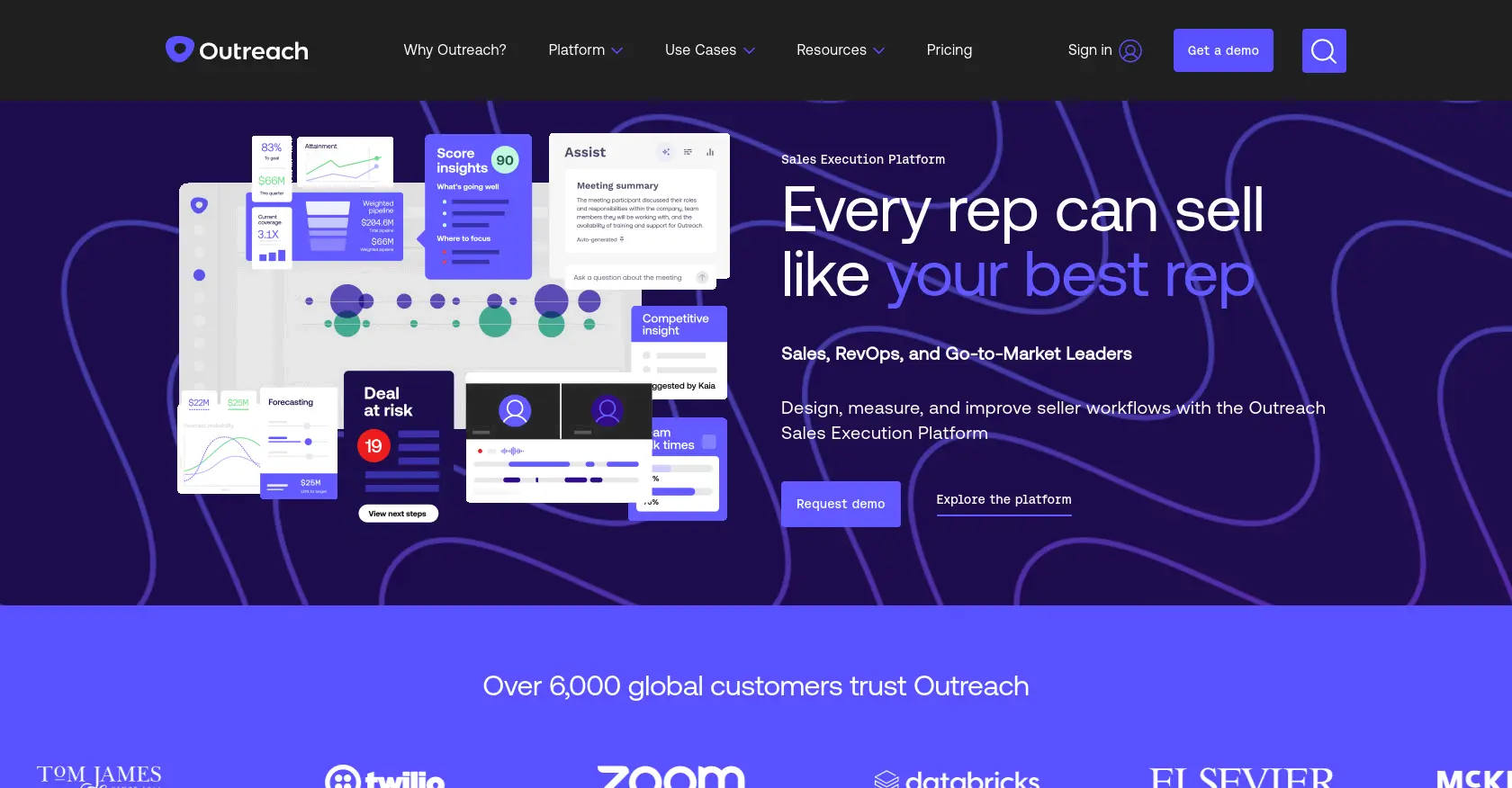
Outreach AI is a multichannel prospecting platform that automates emails, calls and LinkedIn messages. Its built-in AI optimizes personalization and improves response rates, which makes it a popular tool among B2B sales teams.
✔️ Advantages
Full automation of multichannel sequences
Built-in AI to personalize messages
Solid CRM integrations (Salesforce, HubSpot, Zoho…)
Advanced analytics to manage performance
Ideal for structured sales teams
❌ Limits
High price for small companies
Fairly complex initial setup
A learning curve to use all the features
Pricing
Standard → about $100/user/month
Professional → about $130/user/month
Enterprise → custom quote
5. Apollo.io
Rating ⭐⭐⭐⭐⭐ (9,011 reviews)
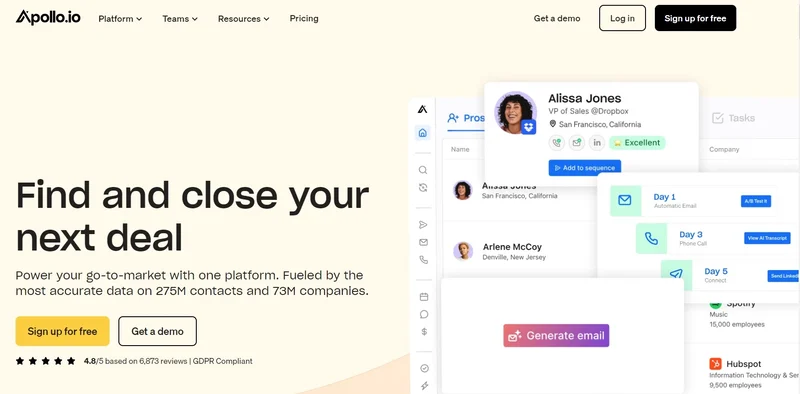
Apollo.io is a B2B prospecting platform that combines an enriched database, multichannel sequence automation and advanced analytics. It lets you quickly identify qualified prospects and launch personalized campaigns at scale.
✔️ Advantages
Access to a very extensive B2B database
Multichannel sequence automation (email, LinkedIn, calls)
Advanced filters to target the right prospects
Smooth CRM integrations to centralize conversations
Good value for money for sales teams
❌ Limits
Data quality varies by region
Advanced features require initial configuration
A learning curve to unlock the tool's full potential
Pricing
Basic → limited free version
Professional → about $49/user/month
Organization → custom quote
6. Lusha
Rating ⭐⭐⭐⭐ (1,533 reviews)
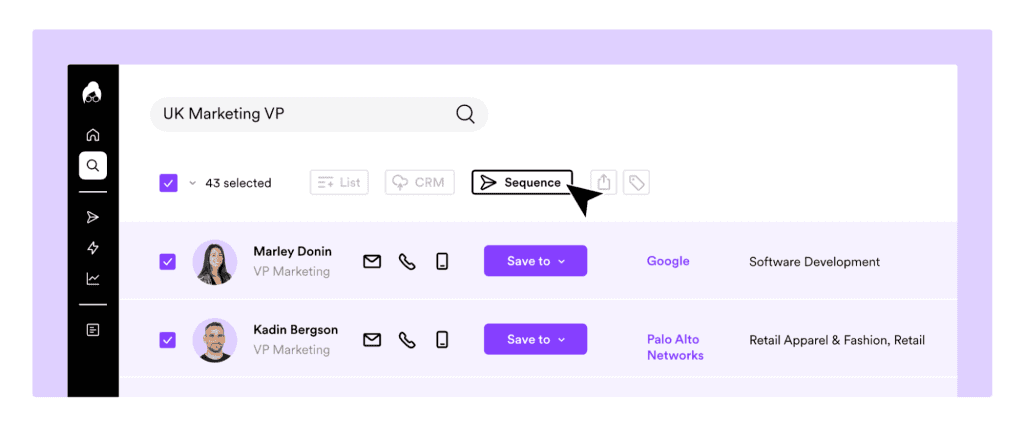
Lusha is a B2B data enrichment platform designed to quickly find prospects' emails and phone numbers. With its Chrome extension and CRM integrations, it makes lead generation easier and speeds up prospecting.
✔️ Advantages
Instant access to verified emails and phone numbers
Handy Chrome extension to prospect directly from LinkedIn
Native CRM integrations (Salesforce, HubSpot, etc.)
Advanced filters and CSV list enrichment
❌ Limits
Credit-based model, which can generate extra costs
Data sometimes incomplete or outdated depending on the industry
Advanced features reserved for the most expensive plans
Pricing
Free → about 50–70 credits per month
Pro → about $22–30/month (billed annually)
Premium → about $50–70/month (billed annually)
Scale / Enterprise → custom quote
7. LinkedIn Sales Navigator
Rating ⭐⭐⭐⭐ (2,055 reviews)
LinkedIn Sales Navigator is LinkedIn's premium tool designed for B2B prospecting. It lets you identify, target and engage the right decision-makers thanks to advanced filters, smart recommendations and better visibility into prospect activity.
✔️ Advantages
Very powerful search filters to target the right prospects
Personalized suggestions based on lead activity and profile
Smooth integration with CRMs (Salesforce, HubSpot, etc.)
Access to detailed information on companies and contacts
Lets you track buying signals and key interactions
❌ Limits
High cost for small companies
A learning curve to fully use all the features
Some information is limited if the prospect restricts their profile
Pricing
Core → about $99.99/user/month
Advanced → about $149.99/user/month
Enterprise → custom quote
8. HubSpot Sales Hub
Rating ⭐⭐⭐⭐ (12,932 reviews)

HubSpot Sales Hub Starter is a complete solution for managing prospecting and sales within a unified CRM. It combines automation, lead tracking, emailing tools, meeting scheduling and reporting, which makes it an excellent choice for B2B teams looking for a simple, effective solution.
✔️ Advantages
Free built-in CRM with contact and deal management
Automation of emails, sequences and follow-ups
Real-time tracking of opens, clicks and interactions
Built-in meeting scheduling and pipeline tracking tools
Intuitive, easy-to-learn interface
❌ Limits
Limited advanced features in the Starter version
More powerful automations available only on higher plans
Can become expensive if the team grows quickly
Pricing
Starter → about $20/user/month
Professional → about $90/user/month
Enterprise → custom quote
Conclusion: multichannel prospecting, a B2B growth lever in 2025
Multichannel prospecting is now a necessity to generate qualified leads and convert more effectively. By combining email, LinkedIn, WhatsApp, cold calling and social networks, B2B teams create more relevant and more human approaches. Effectiveness does not come from a single channel but from their synergy, supported by high-performing tools like Scalability, lemlist, Salesloft or Outreach AI. In 2025, companies that adopt this strategy gain a decisive lead over their competitors.
// Need help?
Outbound that books qualified meetings
Our experts and AI agents build and run your B2B prospecting.
// Key takeaways
Cold email remains the starting point to capture attention
LinkedIn builds credibility and prepares emails, calls and meetings
WhatsApp is best used with prospects who have already interacted with you
Three template sequences: after a demo, strategic account, inactive prospect
Eight tools compared, including lemlist, Apollo.io, Salesloft and Sales Navigator
Frequently asked questions
Which channels should you combine in B2B multichannel prospecting?
This guide keeps email to initiate contact, LinkedIn to identify decision-makers and gain credibility, WhatsApp and messaging apps to get quick replies, cold calling to qualify interest live, and complementary networks like X, Facebook Groups or Reddit for long-term visibility. The strength comes from how they fit together, not from the number of channels.
How do you re-engage a silent prospect after a demo?
This guide suggests a ten-day sequence: a follow-up email summarizing the demo on day 1, a personalized LinkedIn message on day 3, a case study or customer testimonial on day 5, a WhatsApp message to address objections on day 7, then a final email on day 10 with a clear call to action: schedule a call or confirm lack of interest.
Can you prospect on WhatsApp in B2B?
Yes, as long as you stay measured. Favor prospects who have already interacted with you, use a natural tone and short messages, and sync conversations with your CRM. WhatsApp works best as a complement to an email or before a call. Misused, it is quickly seen as intrusive, or even as spam.
How much does a multichannel prospecting tool cost?
According to this guide's comparison, HubSpot Sales Hub Starter starts at around 20 dollars per user per month, Apollo.io at around 49 dollars, lemlist at 69 dollars (99 dollars for Multichannel Expert) and Sales Navigator at 99.99 dollars. Salesloft, Outreach and Scalability work on a quote or on-request basis. Check current pricing before choosing.