Cold email and deliverability
The B2B cold emailing guide (2026)
// Short answer
B2B cold emailing means sending a message to a prospect you have no prior relationship with, to start a qualified conversation rather than sell right away. To make it work, you need controlled deliverability (SPF, DKIM, DMARC, warm-up), precise targeting, a short personalized message with a single call to action, GDPR compliance and regular tracking of your KPIs.
By Benedicte Rivory
7 min read
Eight out of ten buyers prefer to be contacted by email. Yet most prospecting attempts fail because messages are poorly targeted or seen as intrusive. An effective cold email stands out by making a relevant, personalized connection from the very first line.
A cold email is a message sent to a prospect with no prior relationship, designed to start a qualified conversation rather than to sell right away.
Definition: what is a cold email?
👉 A cold email is a message sent to a contact with whom no prior relationship exists, with the aim of starting a professional interaction. In B2B, it is a strategic tool to open a first qualified exchange, as long as you follow best practices and the regulations in force. Unlike spam, cold email relies on precise targeting and in-depth personalization.
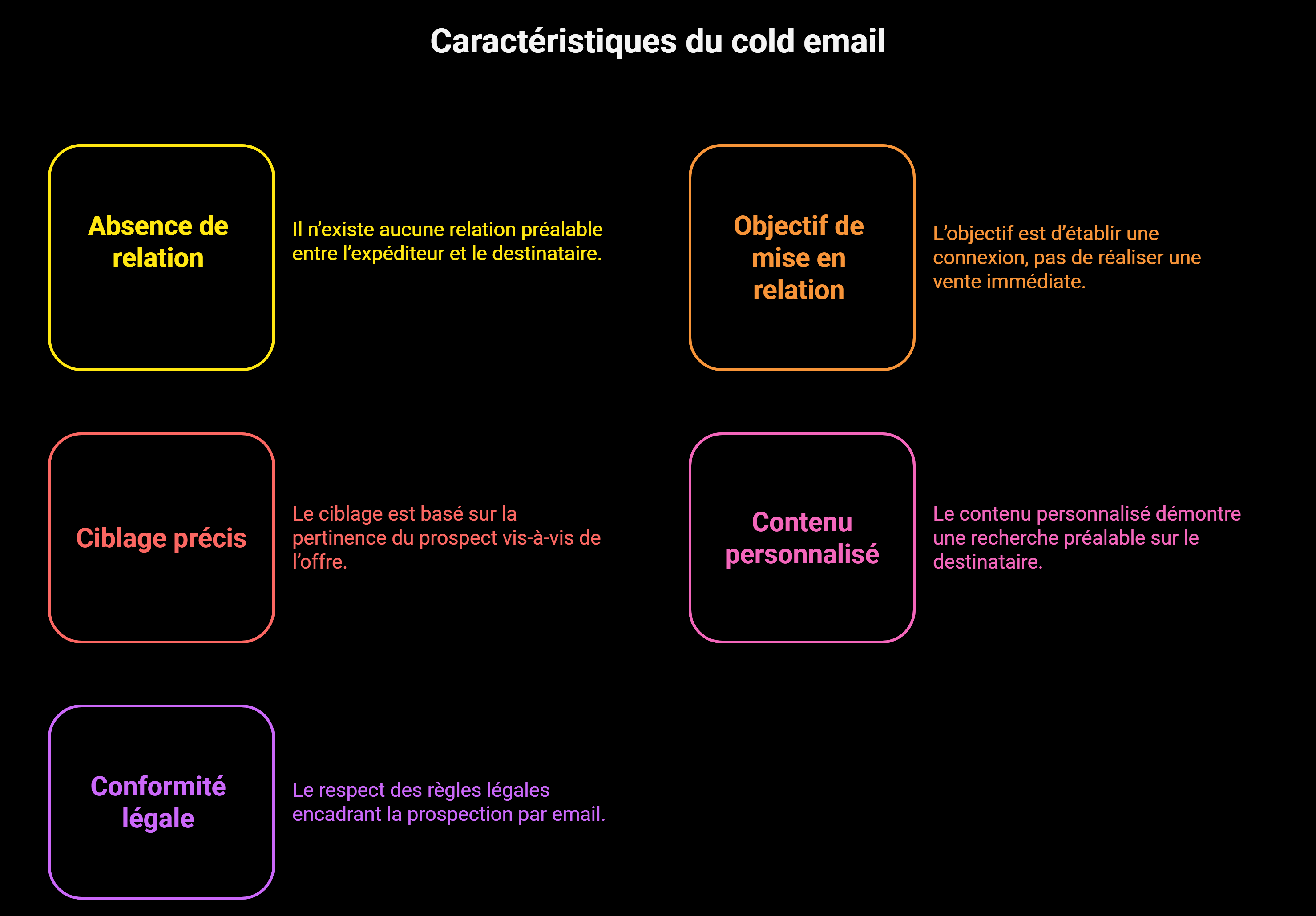
A cold email is defined by:
No prior relationship between the sender and the recipient.
A goal of making a connection, not an immediate sale.
Precise targeting based on how relevant the prospect is to the offer.
Personalized content that shows prior research on the recipient.
Compliance with the legal rules governing email prospecting.
What are the goals of cold emailing?
In B2B prospecting, cold emailing is not meant to close a sale at first contact. Its role is to create an opening, start a dialogue and lay the groundwork for a lasting business relationship. Used correctly, it lets you reach decision-makers who are hard to reach through other channels.
The main goals of B2B cold emailing are:
✔️ Connect with qualified prospects: target the right companies and the right contacts.
✔️ Build awareness: make your solution or expertise known to a targeted audience.
✔️ Identify opportunities: detect needs or ongoing projects at your prospects.
✔️ Start a conversation: get a reply, a meeting or a call.
✔️ Nurture the relationship: open an exchange that can evolve into a sales proposal or a partnership.
What is the legal framework for cold emailing?
In Europe, the General Data Protection Regulation (GDPR) strictly governs commercial prospecting by email. In B2B, it remains allowed on the basis of the company's "legitimate interest", provided that specific criteria are met.
Principle | Description |
|---|---|
Direct link with the recipient's work | The subject of the message must be relevant to the recipient's profession or industry. |
Transparency about data | Clearly state how the contact details were obtained and for what purpose they are used. |
Simple opt-out | Provide a link or notice that makes it easy to unsubscribe immediately. |
Failing to follow these rules exposes you to significant fines and can damage the company's reputation. Effective cold emailing therefore relies on precise targeting, a relevant message and flawless management of personal data.
What is deliverability in cold emailing?
In cold emailing, deliverability is an email's ability to reach the recipient's inbox rather than ending up in spam or being blocked by a filter. A relevant message is useless if it never arrives.
This performance rests on two pillars:
Flawless technical setup to authenticate your sends.
A good sender reputation built over time.
To optimize deliverability, your domain configuration is essential. Three protocols play a central role:
SPF (Sender Policy Framework): checks that the sending server is authorized to send emails for your domain.
DKIM (DomainKeys Identified Mail): adds a digital signature that guarantees the integrity of the message.
DMARC (Domain-based Message Authentication, Reporting, and Conformance): combines SPF and DKIM to define how non-compliant emails are handled.
At the same time, warm-up (gradually ramping up your sending volume) builds a positive history and increases the trust placed in your domain.
How do you write an email that gets replies?
A high-performing cold email relies on concise writing, focused on the recipient and structured to capture their attention from the first line. Each element must have a specific purpose: attract, engage, convince and prompt a reply.
The subject line
This is the first filter: if the subject line doesn't hook, the email won't be opened. It should be short (5 to 7 words), personalized and spark curiosity without being sensationalist. Avoid overly promotional phrases that trigger spam filters.
The opening line or icebreaker
The first lines decide what happens next. Show that the message isn't generic: mention a recent event at the prospect's company, something they published or a shared connection. This immediate personalization builds credibility and encourages them to keep reading.
The pitch
Get straight to the point. Identify a concrete problem the prospect faces and show how your solution can solve it. Favor clarity and brevity: 75 to 125 words in total, talking about concrete benefits for them rather than the technical features of your product.
The call to action (CTA)
End with a single clear question that opens the door to a conversation. Avoid pushing for a sale in the first message; suggest a simple step instead, such as a short phone call or a demo. For example: "Would you be available for a 15-minute call next week?".
💡 Here is a cold email example that applies these principles:
Subject: An idea for your content strategy
Hi [First name],
I read your latest article on [article topic] and enjoyed your perspective on [specific detail]. Several companies in your industry struggle with [specific problem]. By helping [similar company], we were able to achieve [quantified result].
A similar approach could probably bring you value too.
What time would work for you to discuss it briefly?
Best regards,
[Your Name]
The key performance indicators (KPIs) to track
Analyzing results is essential to optimize your cold emailing campaigns. Without regular tracking, you can't identify what works and what holds your performance back.
The KPIs to track first:
Open rate. Measures the effectiveness of your subject lines and your sender reputation. A rate above 50% reflects good targeting and good deliverability.
The reply rate. Assesses how relevant and appealing your message is. For a high-performing B2B campaign, aim for at least 15%.
Conversion rate. Shows the share of replies that turn into qualified meetings or concrete opportunities. This is the KPI that best reflects the business impact of your emails.
Bounce rate. Measures the percentage of emails that were not delivered. A high rate signals an outdated or poorly qualified contact base and hurts your sender reputation.
How do you send cold emails at scale?
In B2B, sending cold emails at scale lets you quickly reach a large volume of qualified prospects. Done well, this strategy multiplies sales opportunities while making the most of your sales teams' time.
The key is not just volume, but quality: fine segmentation, dynamic personalization and precise performance tracking. Each campaign must be designed to address specific segments with a tailored message, while respecting deliverability and compliance rules (GDPR).
Automation plays a central role here. Dedicated platforms let you:
👉 Schedule multi-step sequences with automatic follow-ups.
👉 Personalize messages at scale.
👉 Track opens, clicks and replies in real time.
👉 Adjust campaigns based on observed performance.
To get the most out of this approach, you need a tool that can combine high-volume sending, personalization and technical best practices.
That is exactly what Scalability offers: a solution built to industrialize B2B prospecting, with advanced segmentation, smart automation and precise results tracking. The result: more qualified meetings and a faster sales cycle.
Conclusion
B2B cold emailing works when it is mastered end to end: optimized deliverability, precise targeting, a personalized message and tracking of the right KPIs. A successful campaign is not just a matter of volume, but of balance between relevance and operational efficiency.
For companies that want to structure this approach and roll it out at scale, Scalability offers a complete solution: high-volume sending, advanced personalization, GDPR compliance and detailed performance tracking. Enough to turn your campaigns into a steady flow of qualified meetings.
// Need help?
Outbound that books qualified meetings
Our experts and AI agents build and run your B2B prospecting.
// Key takeaways
Eight out of ten buyers prefer to be contacted by email
In B2B, the GDPR allows cold email on the basis of legitimate interest
Subject line of 5 to 7 words, message of 75 to 125 words, a single call to action
Aim for an open rate above 50% and a reply rate of at least 15%
SPF, DKIM, DMARC and warm-up determine whether you reach the inbox
Frequently asked questions
Is B2B cold emailing legal in France?
Yes. In Europe, the GDPR allows B2B email prospecting on the basis of legitimate interest, under conditions: the message must be directly related to the recipient's work, you must state how and why their contact details were obtained, and you must offer a simple, immediate way to unsubscribe. Non-compliance exposes you to fines.
What is the ideal length for a B2B cold email?
The guide recommends a message of 75 to 125 words in total, with a short subject line of 5 to 7 words. Structure it in four parts: a personalized subject line, an opening line that proves the message isn't generic, a pitch focused on a concrete problem the prospect faces, then a single clear question, such as an offer of a 15-minute call.
What is a good reply rate for cold emailing?
For a high-performing B2B campaign, the guide sets a target of at least a 15% reply rate. An open rate above 50% reflects good targeting and good deliverability. Also track the rate at which replies convert into meetings, as well as the bounce rate: if it is high, your contact base is probably outdated.
Can you send cold emails at scale without ending up in spam?
Yes, if quality keeps up with volume. Segment finely, personalize dynamically and follow deliverability rules: SPF, DKIM and DMARC authentication, a gradual ramp-up of volume (warm-up) and GDPR compliance. Use a platform that can schedule sequences, personalize at scale and track opens, clicks and replies in real time.