Prospecting
5 Steps to Build a B2B Sales Action Plan
// Short answer
To build a B2B sales action plan, follow five steps: analyze the current situation, set SMART goals, prioritize segments and channels, break goals down into operational actions (owner, deadline, KPI), then steer with data. The sales action plan turns your revenue goals into concrete, measurable actions scheduled over time.
By Benedicte Rivory
6 min read
Most companies know what they want to achieve: more revenue, a bigger market share, shorter sales cycles. But the truth is that very few turn these ambitions into a structured, operational and measurable action plan.
A good sales action plan is not a static document or a PowerPoint deck. It is a strategic, execution-focused tool that connects the business vision to results in the field.
What is a sales action plan?
A sales action plan is a strategic document that breaks a company's sales goals down into concrete actions, scheduled over time. It helps you:
Turn overall goals (revenue, market share, profitability) into operational initiatives and tasks.
Organize outreach and lead generation efforts.
Structure the teams' work around clear, measurable priorities.
Schedule actions on a consistent calendar to avoid improvisation or scattered efforts.
Align Marketing, Sales and Customer Success around the same roadmap.
Track sales performance in real time with key metrics.
Quickly spot gaps between forecasts and results (and adjust actions accordingly).
Clarify the roles and responsibilities of each team or team member.
Build on past lessons to better anticipate sales cycles, customer needs or growth opportunities.
💡 Scalability's tip: The lack of a well-structured sales plan is one of the main obstacles to predictable growth. The sales action plan is therefore both a strategic compass and a lever for operational performance.
Why structure a sales action plan?
A structured plan clarifies priorities. It helps mobilize the right resources: budget, team, tools.
👉 It shortens sales cycles. Every step is anticipated, every follow-up is targeted. Decisions are made faster and conversations are more effective.
👉 It aligns teams. Everyone knows what to do, why, and by when. Efforts all point in the same direction.
👉 Pipeline management becomes much smoother. Less time wasted, more qualified deals, a better conversion rate.
👉 When something gets stuck, the plan lets you act fast. Wrong target, unclear messaging, onboarding friction... Adjustments are immediate!
Above all, it gives you a reliable basis for steering. Concrete data, visible results and controlled growth.
5 steps to build an effective sales action plan
1. Analyze the current situation
Before defining a plan, you need to understand what works... and what is stuck. This analysis phase is essential. Without a precise diagnosis, your actions risk missing their target.
It should cover several areas:
Revenue, broken down by segment, channel and geographic area.
Sales performance: closing rate, average cycle length, MRR or ARR generated, no-show rate, post-demo conversion.
Dormant opportunities: inactive prospects, forgotten accounts, leads not followed up.
The quality of the customer portfolio: margin, recurrence, upsell potential, NPS, churn.
Market positioning: competitor benchmark, comparative advantages, differentiating angle.
Too many companies skip this step and build their plan on vague assumptions. The result: they move fast, but in the wrong direction. ❌
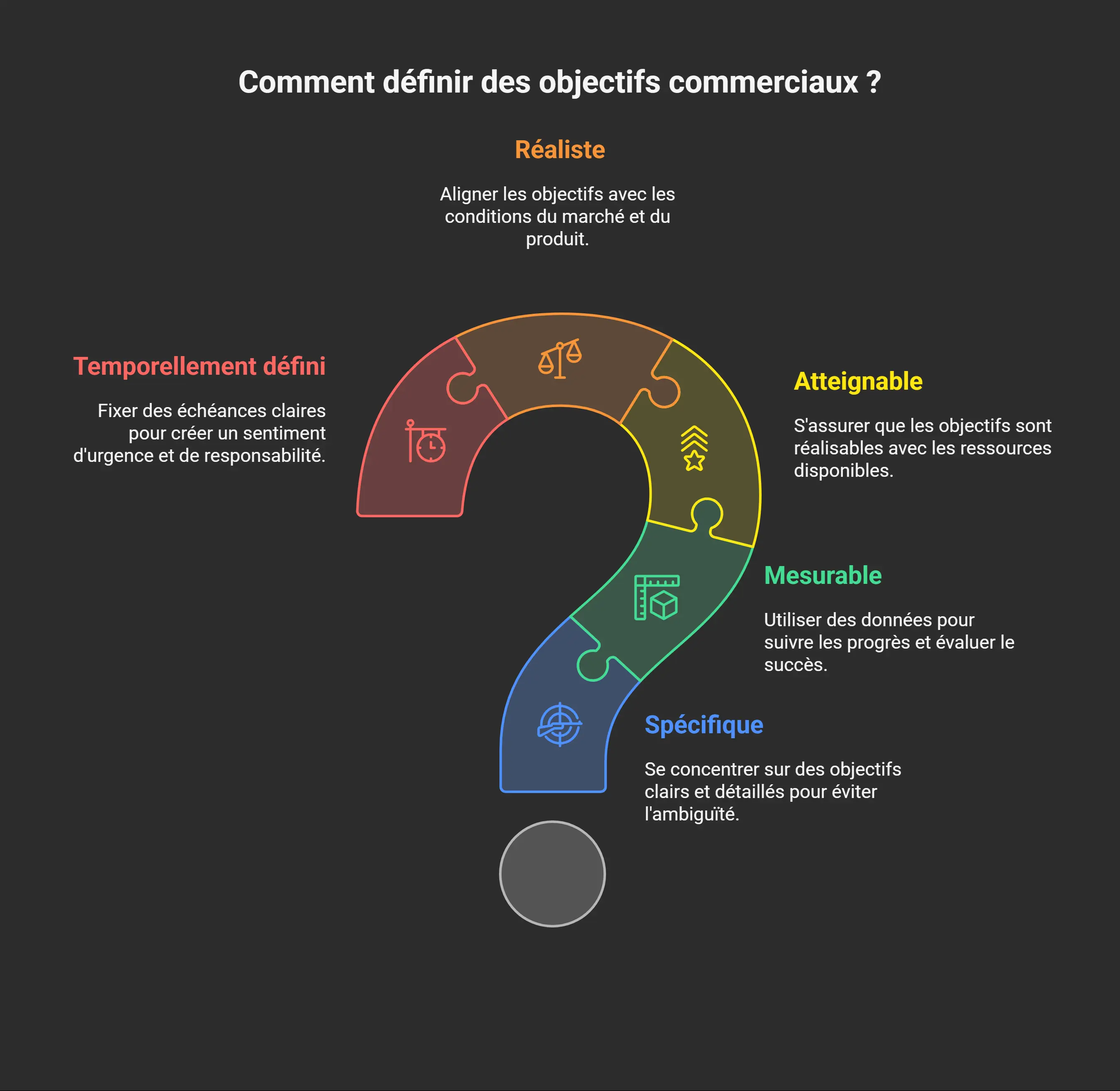
2. Set "SMART" sales goals
Well-defined goals make reliable steering possible. They must be:
Specific → for example, increase the conversion rate on inbound leads from the tech sector by 20%.
Measurable → based on precise data.
Achievable → taking available resources into account.
Realistic → in line with the maturity of the market or product.
Time-bound → with clear deadlines.
The point is not to stack up ambitious numbers, but to set realistic milestones that motivate the team.
3. Prioritize segments and channels
Once the goals are defined, it is crucial to decide where to focus your efforts to maximize return on investment. Prioritizing segments and channels relies on several objective criteria:
👉 Size and potential of each segment: assess the total addressable market (TAM) and the serviceable available market (SAM) for each sector (company size, industry, geographic area). For example, if you find that tech SMBs generate an average MRR 30% higher than traditional companies, this insight should guide your targeting.
👉 Profitability and customer acquisition cost (CAC): compare the average CAC by segment. If the "LinkedIn Ads + content syndication" channel costs 50% more to generate a lead but the LTV (lifetime value) of customers from this channel is 2× higher, it may be worth prioritizing.
👉 Historical conversion rate: analyze past performance: inbound/outbound conversion rate, average sales cycle length, no-show frequency. A segment with a 25% closing rate justifies a higher investment than a segment at 10%, even if the lead volume is lower.
👉 Fit with product/market maturity: some channels (for example, events or trade shows) are better suited to well-established companies, while webinars and content campaigns work better for young startups looking to establish their expertise.
👉 Operational effort and internal resources: a channel can be extremely effective but require advanced skills (e.g. advanced SEO growth hacking). If you do not have the necessary skills in-house, outsourcing or choosing a less technical channel may be a better fit in the short term.
4. Break goals down into operational actions
Defined goal | Action to take | Goal owner | Deadline | KPI(s) to track |
|---|---|---|---|---|
✔️Double the number of MQLs | Launch a targeted SEO + LinkedIn ads campaign | Marketing | Q2 2025 | Qualified leads generated |
✔️Cut the sales cycle by 30% | Optimize the qualification script + automated follow-up | Sales | Ongoing | Average cycle length |
✔️Increase customer lifetime value | Set up a loyalty program + stronger onboarding | Customer Success | Q3 2025 | Net Revenue Retention |
5. Steer with data: 4 decision levers
1. Set up a shared dashboard
Configure a single tool (HubSpot, Salesforce, Notion or Airtable) that brings together the key KPIs (MQL/SAL, pipeline, CAC vs CLTV).
Automate data imports (API/Zapier) and update the critical metrics (pipeline, revenue) every week.
2. Track weekly, monthly and quarterly KPIs
Weekly: check lead volume, the MQL→SQL conversion rate and the number of demos. If a metric drops > 10% vs the previous week, adjust immediately.
Monthly/Quarterly: analyze cost per lead, closing rate and retention, and compare them to your SMART goals to reallocate budgets or efforts.
3. Hold team meetings or 1:1s to adjust in real time
Run a weekly stand-up of 10 to 15 min to share obstacles and priorities (SDR, AE, CSM).
Hold a monthly meeting between Marketing, Sales and CS to validate tactical adjustments (scripts, campaigns, content), and 1:1s to spot coaching needs early.
4. Review underperforming actions: continue or stop?
Define an alert threshold (e.g. ROI < 1.5× cost over 2 months).
Analyze the data quickly (CTR, CAC, lead quality): if a channel keeps underperforming, stop it or adjust the format, then document the lessons learned in a shared space.
A ready-to-use sales action plan example!
Here is a ready-to-use template to structure an effective sales action plan. It is ideal for B2B startups and adapts to every industry. Goals, actions, KPIs... everything is ready!
// Need help?
Outbound that books qualified meetings
Our experts and AI agents build and run your B2B prospecting.
// Key takeaways
A sales action plan breaks sales goals down into concrete actions scheduled over time.
Tracking KPIs weekly generates 20% more revenue than monthly tracking.
Start with a diagnosis: revenue by segment, closing, cycle, dormant opportunities.
Prioritize segments and channels by potential, CAC, historical conversion and resources.
Steer with a shared dashboard, team meetings and an alert threshold for each action.
Frequently asked questions
What should a sales action plan include?
A sales action plan includes a diagnosis of the current situation, SMART goals, priority segments and channels, then an action table. For each goal, this table specifies the action to take, the owner (Marketing, Sales or Customer Success), the deadline and the KPIs to track. It also clarifies everyone's role and aligns teams on the same roadmap.
How do you set SMART sales goals?
A SMART goal is specific, measurable, achievable, realistic and time-bound. For example: increase the conversion rate of inbound leads from the tech sector by 20%, based on precise data, taking into account available resources and market maturity, with a clear deadline. The point is to set realistic, motivating milestones, not to stack up ambitious numbers.
Which KPIs should you track weekly in a sales plan?
Every week, check lead volume, the MQL to SQL conversion rate and the number of demos. If a metric drops by more than 10% compared with the previous week, adjust immediately. Every month or quarter, analyze cost per lead, closing rate and retention, then compare them to your SMART goals to reallocate budgets and efforts.
How do you choose priority prospecting channels?
Compare the potential of each segment (TAM, SAM), the acquisition cost and customer lifetime value by channel, and historical conversion rates. Also check the fit with your maturity: trade shows suit established companies better, webinars suit young startups. Finally, consider your in-house skills: a highly technical channel can be outsourced in the short term.
When should you stop a sales action that is not working?
Define an alert threshold in advance, for example an ROI below 1.5 times the cost over two months. Then analyze the data quickly (click-through rate, CAC, lead quality). If the channel keeps underperforming, stop it or adjust its format, then document the lessons learned in a shared space so you can factor them into future plans.