Prospecting
B2B Prospecting from A to Z, Step by Step
// Short answer
B2B prospecting means identifying, contacting and qualifying business prospects to generate sales meetings and feed a solid pipeline. Step by step: define your ICP, find your prospects, qualify them with scoring, launch a multichannel sequence (email, LinkedIn, call), personalize every message, then support it all with your personal branding. You can also outsource all or part of the process.
By Benedicte Rivory
11 min read
Today, B2B prospecting is being reinvented: with competition on the rise, every interaction counts. Between sharper targeting and deeper personalization, the challenge is clear: build a solid pipeline while optimizing time and costs.
What is B2B prospecting?
👉 B2B prospecting means identifying, contacting and qualifying business prospects to generate sales meetings and feed a solid pipeline.
Unlike inbound, where you wait for prospects to reach out, B2B prospecting actively goes after them. You target the right companies, tailor your message to their context and start a first conversation. This method guarantees a steady flow of leads, even when the market is quiet.
Keep this in mind: B2B prospecting means contacting mostly people who don't know you. And you will see further down in this article that this point is central.
B2B prospecting vs warm outreach: the difference
The main difference comes down to the "temperature" of the contact:
B2B prospecting (cold): you start from zero, with no prior exchange.
Warm outreach: you follow up with a prospect who already knows you (webinar, white paper, trade show).
Criterion | Cold B2B prospecting | Warm outreach |
|---|---|---|
Goal | Generate new leads | Reactivate or qualify existing leads |
Channels | Email, LinkedIn InMail, direct call | Follow-up email, phone follow-up, LinkedIn message after an event |
Type of leads | Unsolicited prospects | Contacts who have already interacted with your brand |
Tone | Direct hook, immediate benefit | More natural conversation, thanks, reminder of the context |
5–15% depending on list quality | 20–40% thanks to familiarity | |
Qualification effort | High (pre-qualification through scoring) | Light (lead already engaged) |
Engagement timing | Longer (several follow-ups) | Shorter (faster conversion) |
💡In practice, (cold) B2B prospecting remains essential to expand your market, while warm outreach maximizes the return on warm contacts. The ideal? Mix both to keep your pipeline fed and speed up meeting booking.
Define your ICP: the first, non-negotiable step
Prospecting becomes ineffective the moment you talk to just anyone. The Ideal Customer Profile (ICP) pinpoints the account most likely to buy quickly and repeatedly. Without this step, every campaign lacks relevance and acquisition costs skyrocket.
Why does the ICP change everything? A well-defined ICP:
→ Steers marketing and sales efforts toward high-potential profiles
→ Lets you personalize your pitch and increase response rates
→ Shortens the sales cycle by targeting prospects who are already mature
Structuring and segmenting ICP profiles
Once you have the data, segment it along three key axes (or more, if needed).
Firmographics (size, revenue, industry)
Decision-making role (CEO, CMO, IT Manager)
Online behavior (downloads, repeat visits)
Is this prospect ready to invest in my offer? Does my offer solve a problem they face? If so, reach out!
Criterion | How to measure it | Segmentation example |
|---|---|---|
Company size | Annual revenue (above/below), headcount | €10–50M • 50–200 employees |
Industry | NAICS/ISIC classification | B2B SaaS • FinTech • Manufacturing |
Contact's job title | LinkedIn title | CMO • VP Sales • CTO |
Digital engagement | White papers downloaded, webinars | > 2 downloads/month |
Find your prospects
B2B prospecting is above all about direct action: it's not about waiting for them to come to you, but going out to find them where they are. Swap the inbound strategy for a structured outbound plan, built on consistent channels and a punchy message.
Where to find information about your ICP?
1. LinkedIn and LinkedIn Sales Navigator • A must-have tool to target your ICP precisely. With advanced search, filters for function, industry, location and buying signals, every prospect you select matches your ideal profile.
2. Professional databases • Platforms like ZoomInfo or Apollo offer exports of qualified lists, including verified email addresses and phone numbers. The time savings are considerable.
3. Referrals and recommendations • Introductions through satisfied customers or partners generate up to 2× higher conversion rates, an often underestimated lever.
4. Events and targeted networking • Round tables, breakfasts and specialized conferences let you make a first informal contact and feed your CRM with warm leads.
Channel | Key strength | Recommended action |
|---|---|---|
LinkedIn Sales Navigator | Ultra-granular targeting and custom alerts | Send 30 InMails/week with A/B subject lines |
Databases (ZoomInfo) | Firmographic data and validated contacts | Import 200 new leads/month |
Referrals | Instant trust, high ROI | Ask for 3 introductions/customer/quarter |
Events & networking | Face-to-face meetings, stronger relationships | Collect 20 business cards/trade show |
A single channel quickly hits its limits.
❌LinkedIn alone can max out your InMail quotas
❌External databases sometimes lack qualitative context and regulatory oversight
❌Referrals and events take longer to set up and cannot be enough on their own
By combining these sources, you multiply entry points without overloading a single lever. Coordinating these actions from your CRM ensures full coverage and a pipeline that is always fed.
Once you have found the profiles, centralize them in a CRM, Notion or a Google Sheets file.
Qualification and scoring: sort to convert better!
Qualifying a prospect means quickly filtering those who match your ICP and focusing your efforts where ROI is highest. This step ensures every follow-up targets a mature contact, reduces wasted resources and speeds up signing.
Why qualify and score?
Without rigorous qualification, 70% of prospecting actions lead to no opportunity at all.
So why qualify and score leads?
✅ Prioritize warm leads rather than piling up cold contacts
✅ Adapt the message to the prospect's level of maturity
✅ Optimize Sales teams' time and speed up the sales cycle
1. Define your scoring criteria
Start by listing 5 to 7 relevant criteria based on your ICP and on the question of how to find prospects who are ready to talk.
Firmographics (company size, industry)
The contact's role or position
The company's budget (recent fundraising? Hiring or layoffs?)
Digital behavior (guide downloads, pricing page visits, presence on LinkedIn or not)
Engagement (email opens, clicks)
2. Apply the 5-step scoring method
Assign a weight to each criterion (e.g. 1 to 5)
Calculate an overall score: weighted sum of the criteria
Set thresholds:
Score ≥ 15: tier 1 – manual approach, free personalized lead magnet, etc.
Score 10–14: tier 2 – personalized sequence
Score < 10: tier 3 – qualify later, keep in the CRM
Automate data collection and calculation (through your CRM or a dataenrichmenttool)
Refresh scores continuously based on new interactions
Multichannel prospecting
A multichannel sequence improves your chances of getting a reply by multiplying touchpoints, while respecting the prospect's pace of engagement. Here is how to orchestrate a consistent, effective flow that gets you as many replies as possible.
Define the ideal sequence
Ready-to-use sequence template:
Step | Channel | Timing after 1st contact | Goal |
|---|---|---|---|
1 | D+0 | Introduction + value proposition | |
2 | D+2 | Personalized invitation | |
3 | D+5 | Short follow-up + new benefit | |
4 | Phone call | D+7 | Direct touch + listening to needs |
5 | D+10 | Final follow-up or high-value content |
Why this cadence?
The initial emails establish contact without being intrusive. They feel 100% natural.
LinkedIn reinforces the legitimacy of the message, visible on your profile.
Thephone call humanizes the approach and allows finer qualification.
💡 Important reminder: the goal of the first cold touchpoint is not to convert, but to get a reply from your prospect.
Ultra-personalized messages
Personalization is the fuel of B2B prospecting: a generic message is doomed to fail, while a tailored approach creates an immediate connection.
By putting the prospect at the heart of your message, you not only increase your open and response rates, you also make your company stand out as legitimate and relevant.
Why personalize?
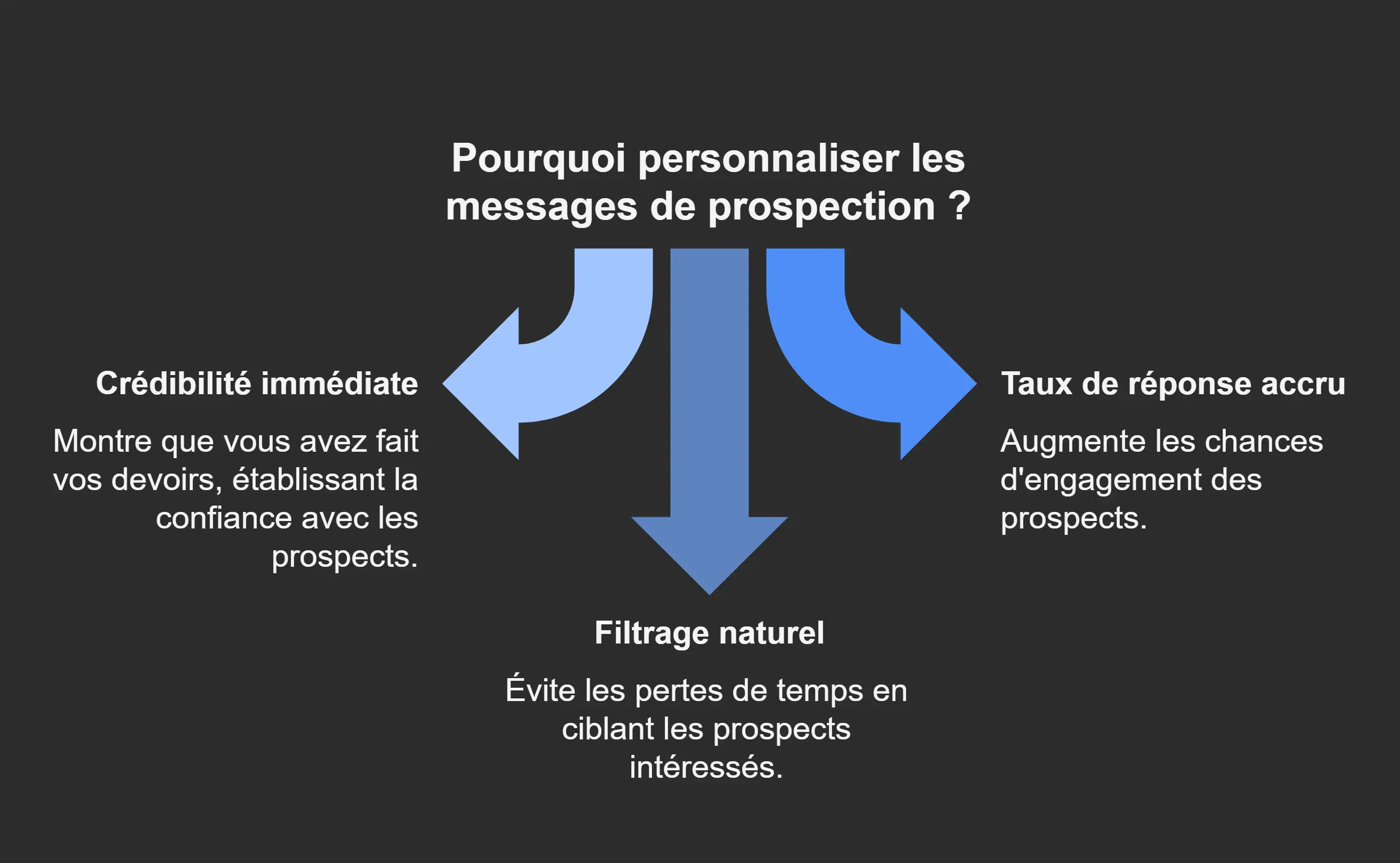
✅ Immediate credibility Mentioning something specific to the prospect (company news, their role, a business challenge) shows you did your homework.
✅ Higher response rate Personalized cold campaigns get up to 25% more replies than a standard send.
✅ Natural filtering Only the recipients who are truly concerned will respond, so you avoid wasting time.
How to structure a personalized message
Gathering insights: spot recent news, a business pain point and something in common. These elements are decisive. If you show up at the right time, with the right solution: you win!
A punchy subject line: short (4-10 words max), including the company name or a quantified benefit. It must grab attention at first glance.
A hook & CTA: immediate mention of the insight, then an offer of an audit or a specific time slot.
A concrete proposal: an open question (mainly for the first contact), a meeting proposal, an offer, etc.
Examples of personalization variables
Here are the personalization variables most commonly used in B2B prospecting. Most automated prospecting tools also let you create "custom" variables.
Variable | Description | Example |
|---|---|---|
{{firstName}} | Contact's first name | Marie |
{{companyName}} | Company name | TechWave |
{{fundingAmount}} | Amount of the recent funding round | €5M |
{{painPoint}} | Main business problem | time-to-market too long |
{{benefitPercentage}} | Quantified benefit to highlight | 30% |
{{meetingDate1}} | First proposed time slot | Tuesday, July 8 at 10 a.m. |
{{meetingDate2}} | Second proposed time slot | Thursday, July 10 at 11 a.m. |
Personalized prospecting message template
Subject: {{companyName}}: cut your time-to-market by {{benefitPercentage}}%
Hi {{firstName}}, Congratulations on your recent {{fundingAmount}} funding round. At Scalability, we help SaaS companies solve {{painPoint}} by automating their cold prospecting sequences. Would you be available {{meetingDate1}} or {{meetingDate2}} for a free mini-audit of your current process? Best regards, {{yourName}} {{yourPosition}}
Outsourced B2B prospecting: a better option?
Outsourced prospecting is increasingly becoming a strategic choice in a B2B environment saturated on the marketing and Sales side.
Why outsource?
👉 Time savings that really matter: delegate research, qualification and outreach to focus on conversion.
👉 Access to new expertise: benefit from proven protocols, optimized scripts and consultants trained in outbound best practices.
👉 Controlled scaling: quickly adjust the number of contacts prospected based on seasonality or budget.
👉 Multichannel coverage: combine email, LinkedIn, phone and SMS without investing in all the tools in-house.
👉 Continuous optimization: benefit from systematic feedback and A/B tests to improve response and meeting rates.
👉 AI skills: build in automatic data enrichment and dynamic AI personalization from day one.
What is Scalability?
Scalability is both a specialized agency for outbound prospecting and a SaaS platform powered byAI, backed by in-house expertise in Sales across a wide range of industries.
A team of experts (sales consultants and data analysts) who design your scripts, segment your lists and optimize your sequences.
An intuitive SaaS platform to deploy multichannel campaigns (email, LinkedIn, call, SMS) in a few clicks; no development needed.
Built-in AI modules for real-time enrichment of prospect data (ZoomInfo, Clearbit), predictive scoring and dynamic generation of personalized messages.
Native integration with the major CRMs (HubSpot, Salesforce, Pipedrive), ensuring two-way sync and automated status tracking.
A unified dashboard that centralizes your KPIs (open, reply and meeting booking rates) and triggers alerts so you can keep adjusting your sequences.
“More than 3 years already and still just as many leads. More and more profitable, unlike Ads, where our budgets had exploded.”
Chloé Bonnefous, Head of Sales @Ubiq
Bonus: personal branding to support your prospecting
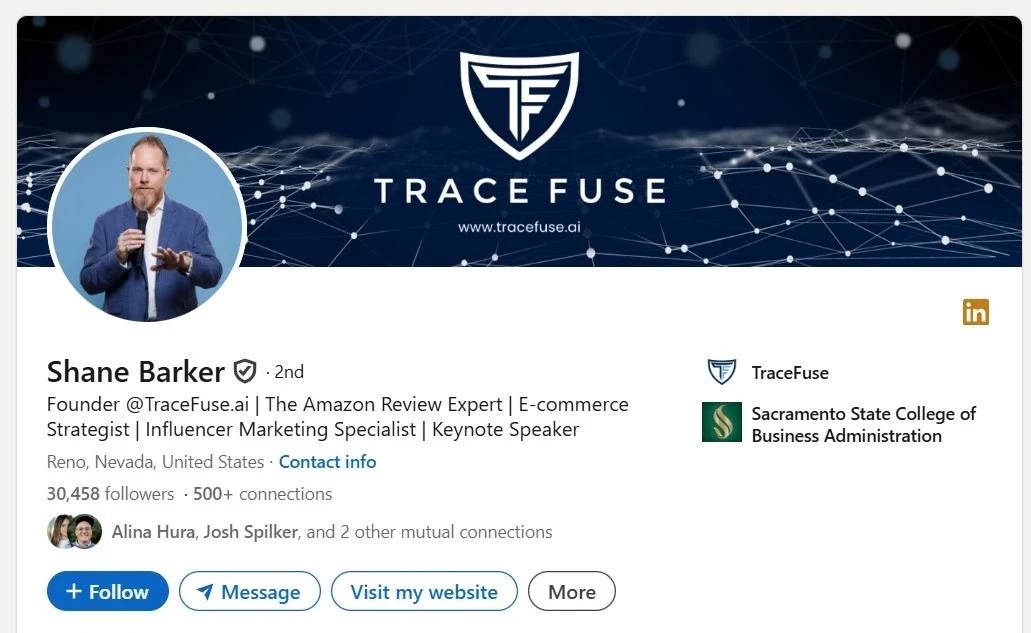
Personal branding on LinkedIn strengthens the credibility of every outreach and creates fertile ground for conversations. When a prospect looks at your profile after a first message, they must immediately see your expertise and legitimacy.
It builds trust from the very first profile visit,
and boosts the impact of your InMails and emails.
1. Polish your profile
Polish your photo and banner: professional portrait + a visual stating your specialty, your tagline, your promise...
Headline: include your keywords (" B2B Prospecting Expert | Multichannel, AI & Agency")
Summary (About): 3 benefit-driven sentences (e.g. "+30% qualified meetings in 3 months") with a discreet link to your methodology
2. Launch your content strategy
Feed your expertise with:
Short posts (1×/week): statistics, practical tips
Short case studies (1×/month): customer successes with figures
Targeted, manual engagement: comment on and share your prospects' posts to stay visible. Don't use AI tools that pollute LinkedIn comment sections and instantly discredit you!
Conclusion
In short, high-performing B2B prospecting combines a precise ICP, coordinated multichannel sequences and strong personal branding.
Next steps:
Finalize your ICP sheet and segment your contact lists.
Set up your email, LinkedIn and call sequences following the recommended cadence.
Optimize your messages with dynamic variables for maximum personalization.
And why not outsource your B2B prospecting to get tangible results quickly and efficiently.
👉 Discover Scalability to automate and scale your B2B prospecting campaigns right now
// Need help?
Outbound that books qualified meetings
Our experts and AI agents build and run your B2B prospecting.
// Key takeaways
The ICP is the first step: without it, acquisition costs skyrocket
Without rigorous qualification, 70% of prospecting actions produce no results
Scoring: 15 points or more for tier 1, 10 to 14 for tier 2, under 10 for tier 3
Typical 5-step sequence from D+0 to D+10: email, LinkedIn, email, call, email
A personalized message gets up to 25% more replies
Frequently asked questions
Where should you start with B2B prospecting if you have no experience?
Start by defining your ICP, the account profile most likely to buy quickly and repeatedly. Segment it by firmographics, decision-making role and online behavior. Then find your prospects through LinkedIn Sales Navigator, databases, referrals and events, and centralize them in a CRM or a spreadsheet.
How do you score B2B prospects simply?
List 5 to 7 criteria (firmographics, job title, budget, digital behavior, engagement), give each a weight from 1 to 5 and calculate a weighted sum. A score of 15 or more justifies a manual approach, 10 to 14 a personalized sequence, and under 10 later qualification. Automate the calculation in your CRM and refresh scores continuously.
What cadence should a prospecting sequence follow?
The guide suggests five steps: an introduction email on D+0, a personalized LinkedIn invitation on D+2, a short follow-up email on D+5, a call on D+7 to listen to needs, then a final high-value email on D+10. The goal of the first cold contact is not to convert, but to get a reply.
What response rate should you expect from cold prospecting?
According to the guide's comparison, cold B2B prospecting gets 5 to 15% replies depending on list quality, versus 20 to 40% for warm outreach thanks to familiarity. That is why it pays to combine both: cold prospecting expands your market, while warm outreach maximizes the return on contacts who are already engaged.
How do you structure a personalized prospecting message?
First gather an insight: recent news, a business pain point or something in common. Write a short subject line of 4 to 10 words that mentions the company or a quantified benefit. Open with that insight, then close with a concrete proposal: an open question, a specific time slot or a mini-audit. Variables like first name, company or funding round make personalization at scale easier.