Leads and data
B2B Lead Generation: B2B Strategies That Convert
// Short answer
B2B lead generation strategies that convert rely on a precise ICP, a clean and enriched database, and a combination of inbound (SEO, content, lead magnets) and personalized outbound (cold email, LinkedIn). Retargeting, nurturing and automation that keeps a human touch complete the setup. Precision and method matter more than lead volume.
By Benedicte Rivory
8 min read
B2B prospecting no longer works the way it used to. Sales teams are running out of steam, databases are outdated, reply rates are collapsing, and lead management is handled worse and worse.
And yet the pressure keeps rising: 19% of B2B marketers cite lead generation as their #1 challenge.
Generating leads has never been so strategic, and never so complex.
Here is everything you need to know about B2B lead generation and how to finally generate qualified leads (and convert them!)
1. B2B lead generation: What is it?
B2B lead generation means identifying, capturing and qualifying contacts who are likely to become customers.
These leads can come from:
forms (ebooks, webinars, demos),
inbound SEO / content,
outbound prospecting,
targeted advertising,
or newer channels (communities, cold DMs, newsletters...).
1.2 Why is generating leads essential in B2B?
No leads, no pipeline. No pipeline, no revenue.
B2B prospecting is a long cycle: several weeks, sometimes several months. You have to feed this cycle continuously, with qualified leads and contacts.
A good B2B lead generation strategy helps you:
anticipate slow periods,
smooth out revenue,
reduce your dependence on word of mouth,
improve the quality of inbound deals.
It is also a predictable growth lever. And a solid foundation to scale without burning your budget, as long as you apply the right methods or have a solid B2B sales action plan.
2. B2B Lead Generation: What are the best methods?
Channel | Effectiveness (conversion) | Acquisition cost | Scalability | Personalization |
|---|---|---|---|---|
SEO / Content | ⚫⚫⚫⚫⚫ | ⚫⚫⚫ | ⚫⚫⚫⚫⚫ | ⚫⚫⚫⚫ |
LinkedIn (organic) | ⚫⚫⚫⚫ | ⚫ | ⚫⚫⚫ | ⚫⚫⚫⚫⚫ |
Cold email + enriched | ⚫⚫⚫⚫ | ⚫⚫⚫ | ⚫⚫⚫⚫⚫ | ⚫⚫⚫⚫ |
Paid Ads (Google, Meta) | ⚫⚫⚫ | ⚫⚫⚫⚫⚫ | ⚫⚫⚫⚫ | ⚫⚫ |
Webinars / events | ⚫⚫⚫⚫ | ⚫⚫⚫ | ⚫ | ⚫⚫⚫⚫⚫ |
2.1 Define your customer persona or ICP
Defining your customer persona, ICP or buyer persona is the first step.
You need to know who you are talking to in order to convince and convert them better.
Build your customer persona based on several criteria:
Their age, their budget, the company structure, the industry (B2B, B2C, hybrid), the problem they face, their funding, etc.
2.2 Inbound: Naturally attract the right leads
Key tools:
SEO + evergreen content (guides, studies, comparisons, listicles). SEO content that educates and guides the prospect from the top of the funnel generates more conversions over the long term than purely promotional content.
Lead magnets: checklists, templates, simulators, etc. You need to deliver value for a very specific, practical need.
Pop-ups and forms on landing pages.
💥 Expert tip: Optimize your pages for targeted, intent-based queries (e.g. "B2B CRM comparison" rather than just "CRM"). This lets you respond more precisely to the specific needs of your ideal customer.
2.3 Outbound: Go after the right accounts
The main outbound methods:
Cold email + personalized sequences
LinkedIn automation + hybrid human/AI approach
Data enrichment to avoid dead leads
87% of LinkedIn messages are not personalized. Personalization is THE key to standing out and converting.
💥 Expert tip: Segment your sequences by prospect maturity, not just by persona.
Want to automate without losing personalization? Scalability designs tailored outbound sequences that combine AI and human strategy.
3. Use LinkedIn to generate highly targeted B2B leads
LinkedIn remains the #1 B2B channel for generating qualified leads. But used poorly, it quickly turns into a noise generator and hurts your reputation on the platform.
3.1 Create an attractive profile
Your profile is not a resume, it is a sales page. It should:
Address a clear problem,
Show social proof,
Call to action (booking a meeting, calendar link...).
💥 Expert tip: LinkedIn favors personal branding over company pages. The company page covers news (products, partnerships, etc.), while the personal profile tells a story and builds trust.
3.2 Contact the right profiles (but without spamming!)
Before any outreach, you need to:
Analyze the profile,
Check relevance (role, industry, maturity),
Personalize the message with something in common or a sharp observation.
3.3 Automate without dehumanizing
Automation tools (lemlist, Waalaxy, Clay...) are useful as long as you follow certain rules:
Target a highly precise database,
Vary your messages and keep a natural tone,
Track reply rates to adjust campaigns continuously.
4. Define a clear ICP: The foundation of any B2B lead generation strategy
A quality lead always starts with a well-defined target. Yet far too many salespeople do not properly define their ideal customer upfront.
4.1 What is an ICP?
The ICP (Ideal Customer Profile) is a description of your ideal customer.
❌ Without a clear ICP, you are aiming at nothing. It is the compass of your prospecting.
A good ICP goes well beyond industry or job title. It includes concrete criteria, such as:
company size (micro-business, SMB, scale-up...),
revenue (and its growth),
tools used (CRM, ERP, CMS...),
business priorities (growth, profitability, international expansion),
business pain points (lack of leads, poor qualification, unclear ROI...).
It is also an alignment tool between marketing, sales and product.
Every team speaks to the same prospect and optimizes every message, every campaign, every demo.
✔️ A well-defined ICP = more relevance, more efficiency and less wasted time.
5. Build a clean, usable database
You cannot generate B2B leads effectively without an up-to-date B2B database.
A "dirty" database = bouncing emails, plummeting open rates, salespeople wasting their time and prospects contacted twice.
It is also a legal issue. GDPR, consent, opt-in... Nothing should be left to chance.
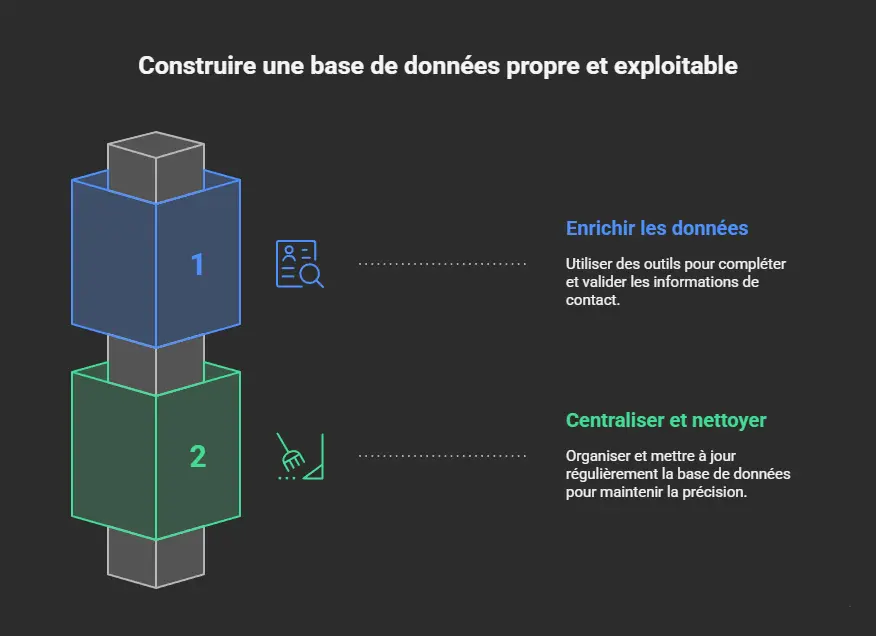
5.1 Enrich data to qualify better
Tools such as Kaspr, Dropcontact, Clearbit or Lusha help you:
complete incomplete records (email, role, LinkedIn),
validate contact details and limit bounces,
capture weak signals: fundraising, job changes, mass hiring...
The fresher the data, the more accurate the messages.
That is the key to personalizing at scale without falling into spam!
5.2 Centralize and clean the database
A good database is a living database.
It needs to be audited, updated and structured regularly.
You need to:
remove duplicates (goodbye double follow-ups),
fix errors (typos in emails, wrong phone numbers...),
segment finely: by industry, by role, by stage of the buying cycle.
A poorly maintained CRM is like a soaked address book: unreadable and useless.
6. Follow up smartly with retargeting
Retargeting turns cold visitors into warm leads. It means retargeting users who interacted with a website or content without taking action.
6.1 Channels to activate
Google Ads: to retarget visitors who viewed key pages (pricing, landing pages, forms...).
LinkedIn Ads: to reach decision-makers who visited a company page or interacted with posts.
Email retargeting: to follow up with contacts who downloaded a lead magnet or started a conversion journey.
7. Automate without losing the "human" touch
Automation is not an end in itself.
It is a lever to save time without sacrificing quality. ✔️
Used poorly, it produces cold messages, out-of-context follow-ups and annoyed prospects.
Used well, it streamlines processes, improves responsiveness and frees up time for what matters: the relationship.
7.1 Workflows to automate
Here are a few ROI-driven automated workflows:
Automatic lead routing by score, channel or persona,
Smart follow-ups based on behavior (opens, clicks, inactivity...),
Enriched, real-time qualification based on the signals collected.
💡 The goal: send the right message, to the right person, at the right time, with no manual intervention.
7.2 Recommended tools
Make or Zapier: to connect your tools (CRM, email, Slack...) without writing a line of code.
lemlist, LaGrowthMachine: to orchestrate highly personalized multichannel sequences.
folk CRM, HubSpot: to centralize data, track interactions and trigger actions automatically.
Powerful tools. But they must be handled with finesse and expertise.
8. AI in B2B lead generation
Artificial intelligence does not replace humans.
But it lets you go faster, further and with more precision.
Used well, it speeds up the entire B2B lead generation cycle:
identification,
qualification,
personalization,
scoring,
follow-up.
8.1 Concrete use cases
Predictive scoring: automatic prioritization based on weak signals (email opens, pricing page visits, job changes...).
Personalization at scale: messages tailored to each profile, generated with fine-tuned AI models.
Lead research: real-time enrichment with tools such as Apollo, Clay or lemlist.
Conversational automation: first exchanges qualified by AI agents (chatbots, AI SDRs...).
8.2 AI vs humans: Which to choose?
❌ AI alone is not enough. Or at least, it is not optimal.
Without strategy, it does not produce results.
Scalability combines the power of automation with human precision:
analysis of real needs,
selection of the right tools,
creation of tailored workflows,
and support at every step.
The right message. To the right target. At the right time.
Without losing what makes the difference: human judgment and expertise.
Conclusion
Effective lead generation is not about quantity, but about precision, method and strategic alignment.
✔ It all starts with a well-built ICP and a clean, segmented database,
✔ The inbound + outbound duo works when it is contextualized,
✔ LinkedIn, combined with data enrichment, lets you target the right accounts,
✔ Nurturing turns passive leads into real opportunities,
✔ Automation frees up time without sacrificing relevance,
✔ And retargeting optimizes every euro invested.
Mastering these levers means building a lead pipeline that is scalable, measurable and truly predictable.
// Need help?
Outbound that books qualified meetings
Our experts and AI agents build and run your B2B prospecting.
// Key takeaways
19% of B2B marketers cite lead generation as their number one challenge
87% of LinkedIn messages are not personalized
A clear ICP aligns marketing, sales and product on the same prospect
A clean database avoids bounces, duplicates and GDPR risks
AI speeds up scoring, personalization and follow-up, without replacing humans
Frequently asked questions
What is the difference between inbound and outbound lead generation?
Inbound naturally attracts prospects through SEO, evergreen content, lead magnets and forms on landing pages. Outbound actively goes after the right accounts: cold email with personalized sequences, a hybrid human and AI approach on LinkedIn, data enrichment. The guide recommends combining both, contextualized to the prospect's maturity.
Which channel should you choose to generate B2B leads?
According to the guide's comparison, SEO and content offer the best effectiveness and strong scalability. Organic LinkedIn costs little and allows strong personalization. Enriched cold email is highly scalable, while paid ads cost more and are less personalized. Webinars convert well but are hard to roll out at scale.
How do you keep a B2B lead database usable?
Enrich your records with tools such as Kaspr, Dropcontact, Clearbit or Lusha to complete and validate contact details, and to capture signals such as a funding round or hiring. Regularly remove duplicates, fix errors and segment by industry, role and buying stage. Also make sure you comply with GDPR and consent rules.
Which lead generation workflows should you automate?
The guide cites three profitable workflows: automatic lead routing by score, channel or persona, follow-ups triggered by behavior (opens, clicks, inactivity) and enriched real-time qualification based on the signals collected. Tools such as Make, Zapier, lemlist, LaGrowthMachine, folk or HubSpot let you set them up without code.