Leads and data
Lead Nurturing: The Guide to Finally Converting Your Prospects!
// Short answer
Lead nurturing is a strategy that consists of maintaining the relationship with prospects who are not yet ready to buy, by sending them useful content suited to their maturity until they convert. It is built in four steps: segment your audience, set up lead scoring, map your content to each stage of the journey (TOFU, MOFU, BOFU) and automate your scenarios.
By Benedicte Rivory
6 min read
👉 Lead nurturing is an acquisition strategy that consists of building and maintaining relationships with prospects who are not yet ready to buy.
This approach solves a crucial problem: what do you do with contacts who are interested but not yet ready for a sale? By supporting them with relevant content, you guide them all the way to conversion. In fact, companies that excel at this practice generate 50% more qualified leads at a 33% lower cost.
In B2B, as we know, sales cycles are long and lead management is increasingly time-consuming. A single touchpoint is no longer enough. Rather than bombarding your leads with offers, you build a lasting relationship. You stay top of mind until they are ready to talk.
Without this method, you are leaving money on the table.
The goals of lead nurturing
A well-designed nurturing strategy is not just about sending a few more emails. Its purpose is to build a solid relationship to reach clear business goals.
With this approach, your database becomes a real growth engine. Your sales teams finally receive prospects who are qualified, informed and ready to talk.
The main goals are simple:
✅ Increase conversion rates by supporting each lead throughout their decision process.
✅ Shorten the sales cycle by providing the right information at the right time.
✅ Improve the quality of leads sent to sales reps, which multiplies their effectiveness.
✅ Maximize the return on investment (ROI) of your marketing by no longer wasting a single contact.
✅ Make the most of prospects already in the CRM by (re)contacting them at the right time
4 steps for a nurturing workflow that works
To make it work, you can't leave things to chance.
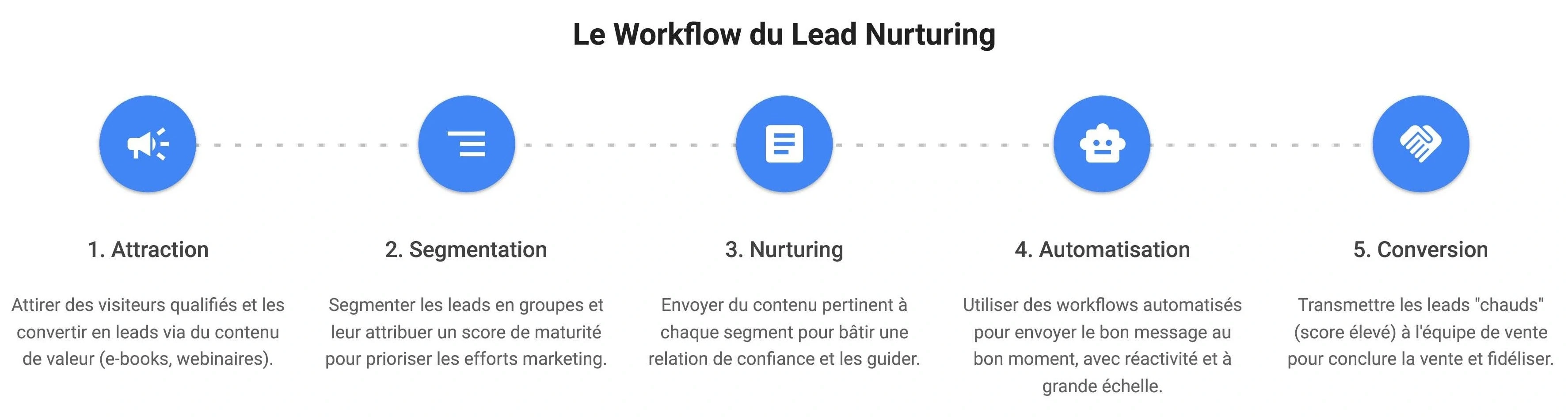
A well-structured process is the key. It is organized around four main steps that make sure your actions are always relevant.
Step 1: Segment your audience
Everything starts with an excellent knowledge of your prospects. Without segmentation, you are shooting in the dark. Group your leads according to logical criteria.
Use demographic data (industry, job title) and behavioral data (pages viewed, clicks, downloads). This segmentation lets you send ultra-personalized messages. Each lead receives information that speaks to them directly.
Step 2: Set up lead scoring
How do you know which prospects are the hottest? Lead scoring is your best ally. This technique assigns points to each contact based on their profile and actions.
A prospect who ticks every box of your ideal customer and interacts a lot with your content will have a high score. This system tells you where to focus your efforts. It alerts sales reps when a lead is ready to be called. It is a pillar of marketing and sales alignment.
Step 3: Map your content
Content is the fuel of your strategy. It must be perfectly suited to each prospect's stage of maturity.
For each stage of the journey, plan the right formats:
Awareness (TOFU): Blog posts, infographics, guides to educate and grab attention.
Consideration (MOFU): White papers, case studies, webinars to help compare solutions.
Decision (BOFU): Demos, free trials, customer testimonials to reassure and trigger the purchase.
Step 4: Automate your scenarios (workflows)
This is where the magic happens and saves you a huge amount of time. Workflows are sequences of automatic actions triggered by your leads' behavior.
A prospect downloads an e-book? A workflow starts and sends them a series of emails to dig deeper into the topic. A contact goes inactive? A re-engagement campaign kicks off. Automation ensures highly responsive communication without you having to lift a finger.
The key performance indicators (KPIs) to keep an eye on
So how do you know if your efforts are paying off? By tracking the right indicators. They are the ones that will tell you what works and where you need to adjust.
Forget "vanity metrics." Focus on data that has a direct impact on the business.
Here are the essential KPIs to watch:
The conversion rate from lead to MQL (Marketing Qualified Lead) and from MQL to SQL (Sales Qualified Lead).
The average length of your sales cycle.
The engagement rate on your content (clicks, replies).
The overall ROI of your campaigns.
To sum up, nurturing changes the game in your relationship with your prospects. You stop selling and start helping. By bringing value well before talking business, you become a trusted partner.
This strategic approach gets the most out of every lead you generate. It puts your marketing and sales teams on the same page for healthy, sustainable growth.
The essential lead nurturing tools
To orchestrate your lead capture and nurturing strategy, you need:
👉 A unified CRM: Salesforce, HubSpot, Pipedrive, etc., to centralize every contact and interaction history.
👉 Marketing automation: ActiveCampaign, Brevo to create workflows, segment your lists and trigger your sequences.
👉 Custom forms and pop-ups: Typeform, Intercom or Tally to grab attention and capture tailored leads.
👉 Data enrichment: Clearbit, ZoomInfo, PhantomBuster to automatically complete prospect profiles.
To maximize efficiency and align your tech stack with your goals, an expert partnership makes all the difference. That is exactly what Scalability brings: tailored configuration, smooth integration and continuous optimization of your pipeline.
Ready to transform your acquisition? Discover Scalability and turn your tech stack into a real growth engine.
Conclusion
In short, a high-performing lead generation and nurturing strategy relies on:
Precise targeting (refined ICP) to speak directly to your ideal prospects
Tailored lead magnets that trigger capture and reveal real interest
Smart automation (pop-ups, chatbots, sequences) to engage without manual effort
Continuous enrichment & scoring to focus your resources on strong opportunities
F.A.Q.
What is nurturing in marketing?
Nurturing, or "prospect maturation," is a marketing strategy that consists of building a lasting relationship with contacts who are not yet ready to buy. The idea is to support them with useful content to move their thinking forward until they become customers.
What is the role of lead nurturing in marketing automation?
Marketing automation is the engine that drives lead nurturing. This technology lets you automatically send personalized communications, such as emails, based on the prospect's profile and behavior. Thanks to automated scenarios, or workflows, you send the right message to the right person at the right time.
How do you do nurturing?
Effective nurturing requires a structured process. It starts with segmenting your contact database into relevant groups. Next, you need to create content suited to each segment and build it into automated scenarios, or workflows. Using lead scoring helps you identify the most mature prospects. Finally, continuous performance analysis is essential to optimize your strategy.
Why do lead nurturing?
Lead nurturing is profitable because it increases conversion rates by keeping prospects from being forgotten. It qualifies leads better, which saves your sales reps valuable time. In the end, it generates a much better return on investment than isolated marketing actions.
// Need help?
Outbound that books qualified meetings
Our experts and AI agents build and run your B2B prospecting.
// Key takeaways
Done well, nurturing delivers 50% more qualified leads at a 33% lower cost.
Goals: more conversions, a shorter sales cycle, better-quality leads.
4-step workflow: segmentation, scoring, content mapping, automation.
Content adapts to each stage: awareness, consideration, decision.
Key KPIs: lead-to-MQL and MQL-to-SQL conversion, sales cycle, engagement, ROI.
Frequently asked questions
What content should you send at each stage of lead nurturing?
In the awareness stage (TOFU), use blog posts, infographics and guides to educate and grab attention. In the consideration stage (MOFU), offer white papers, case studies and webinars that help compare solutions. In the decision stage (BOFU), rely on demos, free trials and customer testimonials to reassure and trigger the purchase.
What is the link between lead nurturing and marketing automation?
Marketing automation is the engine of nurturing. It automatically sends personalized communications, such as emails, based on the prospect's profile and behavior. For example, an e-book download triggers a series of emails to dig deeper into the topic, and an inactive contact receives a re-engagement campaign, with no manual action on your part.
How does lead scoring help nurturing?
Lead scoring assigns points to each contact based on their profile and actions. A prospect close to your ideal customer who interacts a lot with your content gets a high score. This score tells you where to focus your efforts and alerts sales reps when a lead is ready to be called. It is a pillar of marketing and sales alignment.
What tools should you use for lead nurturing?
The guide names four families of tools: a unified CRM (Salesforce, HubSpot, Pipedrive) to centralize contacts and histories, a marketing automation platform (ActiveCampaign, Brevo) for workflows and segmentation, forms and pop-ups (Typeform, Intercom, Tally) to capture leads, and data enrichment tools (Clearbit, ZoomInfo, PhantomBuster) to complete profiles.
Why nurture contacts who are already in the CRM?
Your CRM often contains prospects who are interested but not yet ready. Contacting them again at the right time with relevant content keeps them from being forgotten and makes the most of a database you have already built. This approach increases conversion rates, gives sales reps better-qualified leads and improves return on investment compared with isolated marketing actions.