Prospecting
What Is Warm Outreach? Definition and Strategies
// Short answer
Warm outreach means contacting prospects who have already shown a sign of interest: a visit to your website, a newsletter signup, an interaction on LinkedIn or attending a webinar. Instead of starting from scratch, you build on that signal to send a relevant message at the right time. The result: higher reply and conversion rates and a shorter sales cycle.
By Benedicte Rivory
6 min read
Cold outreach is saturated. Every day, more than 100 million prospecting emails are sent. In this constant noise, the average interest rate has dropped from 0.5% to less than 0.1%.
Inboxes are overflowing with copy-pasted messages. The result: prospects ignore, delete or report them.
It is time to rethink prospecting beyond mass automation.
That is where warm outreach really makes sense.
When every interaction builds on a signal, a behavior or an existing touchpoint, engagement becomes natural and conversions follow.
What Is Warm Outreach?
Imagine prospecting that does not intrude.
A message that arrives at the right time, to the right person.
No pushing. Just a real conversation that starts naturally.
That is warm outreach: contacting prospects who have already shown a sign of interest: a visit to your website, a newsletter signup, an interaction on LinkedIn, attending a webinar, etc.
You do not start from scratch. You build on an existing foundation.
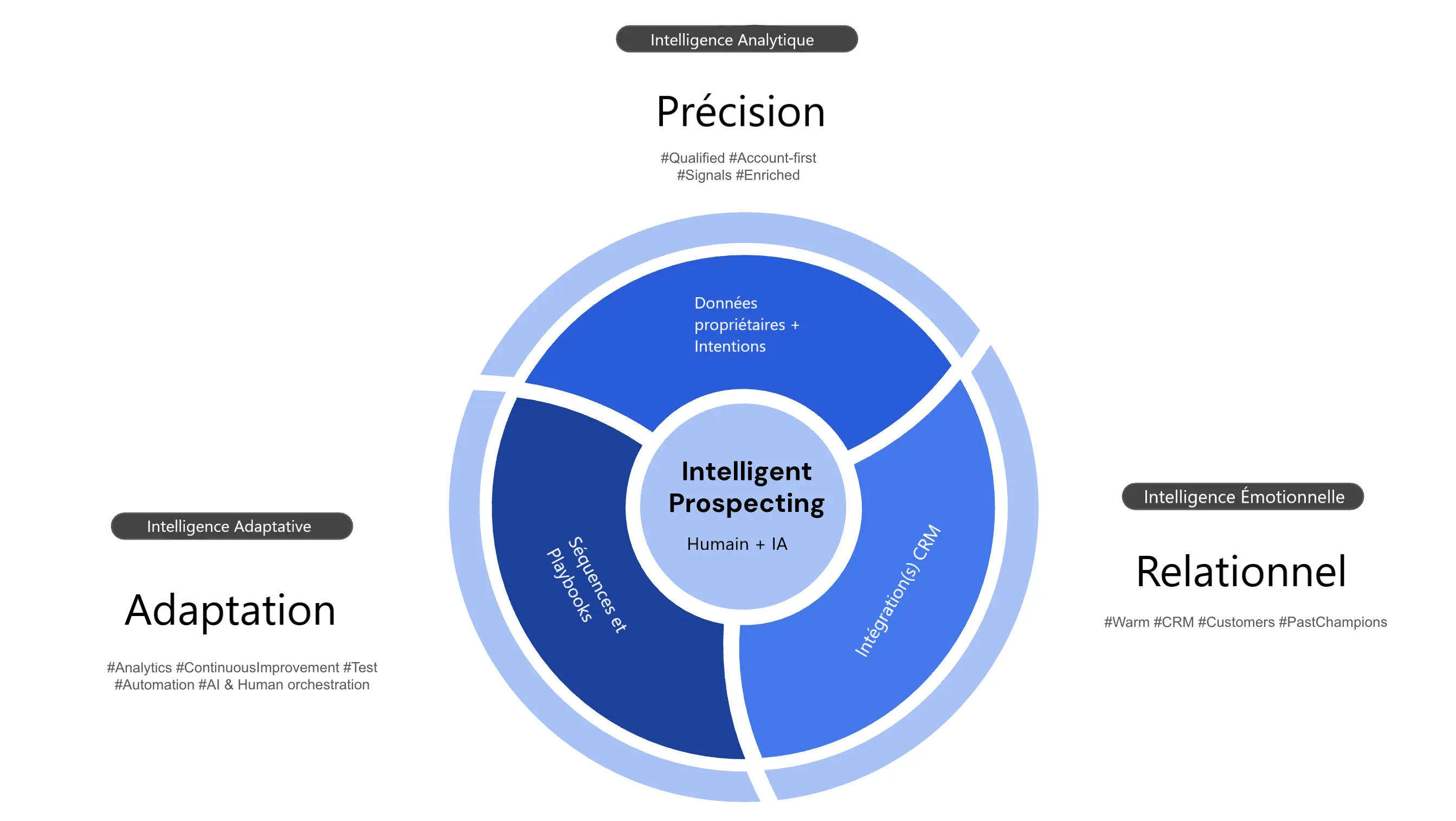
With AI, data and human expertise, this approach becomes scalable without losing its personal touch.
You move:
from chance to precision,
from the standard message to the tailored message,
from a transactional relationship to a lasting relationship.
Smart prospecting starts here.
Why Is Warm Outreach Essential in B2B?
Warm outreach is an essential strategic approach in B2B. It optimizes prospecting by targeting prospects who are already aware of your offer.
1. Higher conversion rates
"Warm" leads have much higher conversion rates than "cold" leads. For example, calls to prospects who have already interacted with your company show a conversion rate of 20 to 30%, compared with only 1 to 2% for cold calls.
In a market where more than 30 million French LinkedIn profiles are actively worked by SEPs (Apollo, Lemlist, Pharow, Zeliq...), the competition for attention is fierce. Warm outreach lets you stand out intelligently, while most people keep shooting in the dark.
Stage | Average conversion rate | Source |
|---|---|---|
Reply (interest expressed) | 60% | |
Meeting booked | 20% | |
Closing (deal won) | 20-30% |
2. A shorter sales cycle
By reaching out to prospects who are already engaged, the sales process speeds up. "Warm" leads have already gone through some stages of the buying journey, which reduces the time needed to close a deal.
➡️ Warm outreach campaigns cut the time between first contact and signature ("closed won") by 20% on average, according to Scalability's field observations across hundreds of B2B sequences.
3. Better use of resources
Focusing efforts on qualified leads optimizes return on investment. Warm outreach campaigns maximize sales team efficiency by focusing on prospects with strong conversion potential.
🤝 By adding warm outreach to your B2B prospecting strategy, you significantly increase your chances of conversion, reduce the time needed to close a deal and optimize the use of your resources.
It is a strategic approach that meets today's market demands and helps you build strong relationships with your prospects (and future customers!)
Warm Outreach vs Cold Outreach: What Are the Differences?
Criterion | Cold Outreach | Warm Outreach |
|---|---|---|
Prior relationship | None | Interaction or interest already shown |
Low (1-5%) | Higher (up to 34%) | |
Sales cycle | Long and uncertain | Shorter, trust already established |
Perceived risk | High (spam, rejection) | Low (relationship already started!) |
Effort required | High volume, more limited personalization | Targeted, contextual approach, personalized messages |
✔️ Warm outreach builds on existing signals of interest, delivering higher conversion rates and a shorter sales cycle.
✔️ Cold outreach takes more effort to build trust and get replies.
Warm Outreach: Methods and Channels
Channel | Main goal | Execution |
|---|---|---|
Personalized emailing | Start the conversation with a targeted message | Writing personalized email sequences that include specific signals of interest to capture prospects' attention. |
Strengthen presence and engagement on social networks | Automating profile visits, connection requests and messages, while keeping a human, relevant approach. | |
Phone calls - "Warm Call" | Establish direct, personal contact | Adding strategic calls to sequences, timed for the right moments to maximize impact and conversion. |
Manual tasks | Personalize the approach further | Adding reminders for specific actions, such as commenting on the prospect's LinkedIn post, to create authentic interactions and strengthen the relationship. |
Note: A multichannel approach maximizes touchpoints with your prospects. For example, a lead can first interact with your content on LinkedIn, then receive a personalized email.
Warm Outreach: 5 levers to turn intent into real opportunities
Warm outreach cannot be improvised. Here are the pillars to master to turn signals of interest into real opportunities.
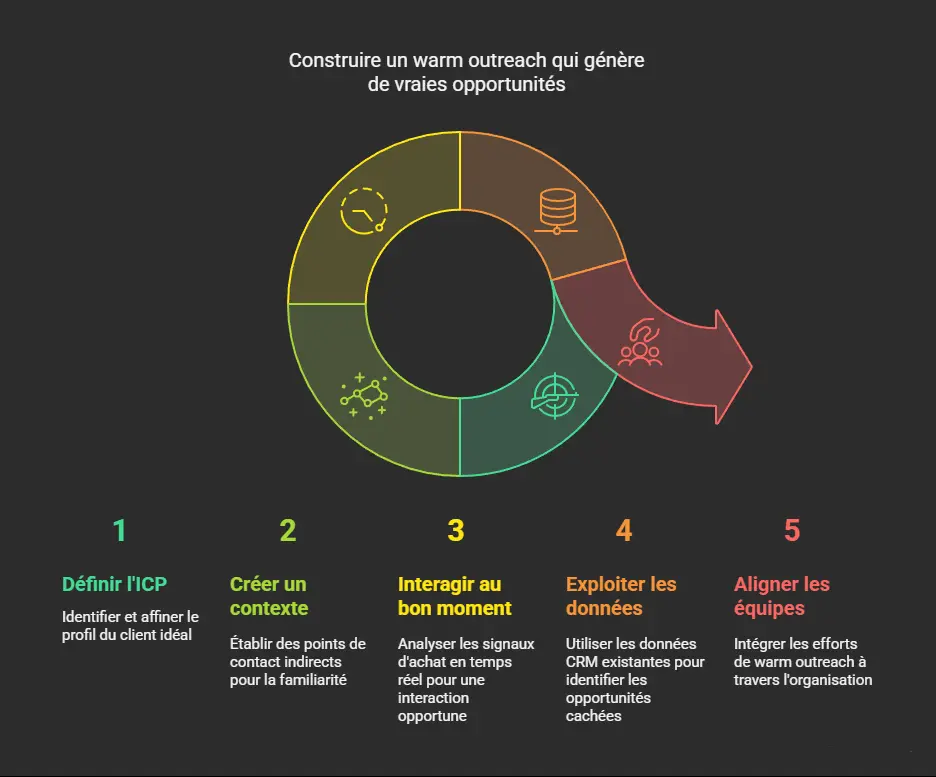
1. Precise ICP targeting
It all starts with a clear, refined ICP. The better your targeting is defined, the more your prospecting reaches people who are truly concerned. The goal: talk to people with real buying intent, not to a broad but poorly qualified audience.
2. Create a favorable context
Prepare the ground before interacting or sending a message. Multiplying indirect touchpoints (visits, interactions, reactions) makes the approach feel more natural. The contact becomes a logical next step, not an intrusion. Your chances of getting replies rise sharply.
3. Engage at the right time
Analyzing buying signals in real time lets you step in when the prospect is ready to talk. Based on reliable data, outreach becomes relevant, far more than a simple "cold" message.
4. Use existing data
Your CRM, internal databases and network connections already contain leads you can activate. Identifying these hidden opportunities and cross-referencing them with detected signals optimizes results without starting from scratch.
5. Align all teams
Warm outreach has more impact when it is built into every level of the organization. By pooling tools, data and learnings, the approach becomes consistent, predictable and scalable.
Should you add AI to your warm outreach strategy?
Do you have to choose between artificial intelligence and humans to do good warm outreach? The answer is simple: both are useful, and above all, complementary.
AI saves time, analyzes the right signals and personalizes at scale. It connects data, identifies the right moments to act and automates time-consuming tasks.
But without a human touch, prospecting quickly becomes cold and impersonal. Authentic messages, relevant comments and sincere exchanges are what make the difference.
The ideal? A hybrid approach: smart tools to aim right, and human execution to create real conversations.
Scalability combines AI, human expertise and unified data to create personalized outbound prospecting. Targeted connections, authentic interactions, relevant messages: every contact is a real opportunity, designed to generate value and conversions.
Warm Outreach: Conclusion
Warm outreach is a powerful strategy to engage prospects who are already aware of you and to increase your conversion rates. By combining personalization, strategic timing and a multichannel approach, you can build strong, lasting relationships with your potential customers. Adding warm outreach to your B2B strategy is essential to stay competitive and maximize your return on investment.
// Need help?
Outbound that books qualified meetings
Our experts and AI agents build and run your B2B prospecting.
// Key takeaways
Calls to already engaged prospects: 20 to 30% conversion, versus 1 to 2% cold
Reply rate: 1 to 5% for cold outreach, up to 34% for warm outreach
About 20% shorter sales cycle according to Scalability's observations
Channels: personalized email, LinkedIn, warm call and manual tasks
Recommended approach: AI to aim right, humans to hold the conversation
Frequently asked questions
What is the difference between warm outreach and cold outreach?
Cold outreach contacts people with no prior relationship, with high volume, limited personalization and 1 to 5% replies. Warm outreach targets prospects who have already shown interest, with a targeted, contextual approach that can reach 34% replies. The risk of rejection is lower and the sales cycle is shorter.
Which signals of interest should you use for warm outreach?
The guide cites visits to your website, newsletter signups, an interaction on LinkedIn or attending a webinar. Your CRM, internal databases and network connections also contain leads you can activate. Cross-reference this data with buying signals detected in real time to step in when the prospect is ready to talk.
How do you prepare the ground before a first message?
Multiply indirect touchpoints before writing: profile visits, reactions and relevant comments on the prospect's posts. Your message then becomes a logical next step rather than an intrusion. Add manual tasks to your sequences, such as commenting on a LinkedIn post, to create authentic interactions that clearly increase your chances of a reply.
Should you use AI for warm outreach?
AI and humans are complementary. AI saves time: it analyzes signals, identifies the right moment to act and personalizes at scale. Without a human touch, prospecting quickly turns cold. The guide recommends a hybrid approach: smart tools to target accurately and human execution to hold real conversations.