Leads and data
The Complete Guide to B2B Data Enrichment
// Short answer
B2B data enrichment means completing, updating or correcting the data of a contact or a company using third-party sources. It helps you qualify leads better, personalize messages and automate marketing and sales workflows. It can be done in three ways: manually, through a waterfall (several cross-checked sources) or automatically via API, in compliance with GDPR.
By Benedicte Rivory
9 min read
B2B data enrichment is no longer optional. It is the starting point of any effective lead generation strategy. In a market where conversion rates are stagnating and competitors all draw on the same contact databases, access to richer, fresher, more actionable data makes all the difference.
32% of sales reps' time is wasted contacting the wrong prospects because of inaccurate or incomplete data. Without enrichment, outbound tools run on empty.
What is B2B data enrichment?
B2B data enrichment means completing, updating or correcting the data of a contact or a company using third-party sources. This helps you qualify leads better, personalize messages and automate marketing & sales workflows.
What types of B2B data get enriched?
Location
Industry
Revenue
Year founded
B2B / B2C
Language spoken
Certifications and degrees
Universities and schools
Previous companies
Event attendance
Company page followers
New promotions
Name, job title, company
Company size, sector/industry, revenue
Technologies used (the tech stack)
Buying intent
Behavior (visits, interactions)
Profiles on social networks (LinkedIn, Twitter...)
Why enrichment is essential to lead generation
Better targeting, better conversion: personalized emails convert 6x more than generic ones.
Sales/marketing alignment: everyone works with the same up-to-date, actionable information.
Sharper automation: sequences and scoring are based on real data, not assumptions.
Dynamic segmentation: tailoring your messages to the prospect's size, industry or maturity sharply increases your response rate.
Acting at the right time: intent data helps you capture weak signals and act when the prospect is actively searching (and most likely to convert).
Regulatory compliance: enrich without abusive collection. GDPR allows the use of B2B data if legitimate interest is demonstrated, but requires you to guarantee its accuracy, its origin and the ability of the people concerned to exercise their rights.
How does data enrichment work? 3 methods
In short: Enrichment can be manual, automated or combined. Each method has its uses and its limits, and raises reliability and compliance issues. Enrichment can be paired with debounce, which means verifying each email address so you have a ready-to-use contact list.
1. Manual enrichment
Done by a person who researches LinkedIn, company websites or public databases.
✔️ Strengths: high accuracy, full control over data verification.
❌ Risks: very time-consuming, poorly suited to large volumes, costly in human resources.
2. Waterfall enrichment:
Combines several sources to cross-check, complete or validate data (e.g. Dropcontact for the email, LinkedIn for the job title, etc.)
✔️ Strengths: broader coverage, considerable time savings, better completion rate, reliable.
❌ Risks: inconsistencies between sources, duplicates, sometimes unclear traceability. Vigilance is essential to stay GDPR compliant.
3. Automated enrichment via API:
Direct integration into forms, CRMs or marketing tools. Enrichment happens in real time from a third-party database.
✔️ Strengths: time savings, large-scale processing, automated process.
❌ Risks: dependence on the quality of vendors' data, costs that vary with the volume processed.
The best B2B data enrichment tools
Tool | Strengths | Monthly price (from) | GDPR compliance |
|---|---|---|---|
Outsourced prospecting, human + tech enrichment | Custom quote | ✅ Yes | |
Verified business emails, API, CRM, 100% GDPR | €24/month (500 credits) | ✅ Yes | |
Chrome extension, unlimited emails, mobile numbers | Free + plans from $49 | ⚠️ Partial | |
Real-time API, complete firmographics | Custom quote | ❌ Non-EU | |
Multichannel prospecting + built-in enrichment | From $39/month | ✅ Yes | |
Waterfall enrichment, triple verification | $29/month | ✅ Yes | |
Enrichment + prospecting + built-in CRM | Free + plans from $49 | ✅ Yes | |
Verified mobile numbers, strong compliance, advanced CRM | Custom quote | ✅ Yes | |
Huge database, real-time insights, sales integrations | From $15,000/year | ✅ Yes (to be checked) | |
Intent data, buying signals, job changes | Custom quote | ✅ Yes |
1. Scalability
Summary
Scalability is not just a tool but a hybrid solution. They run your outbound for you, with highly targeted data enrichment, driven by humans and powered by an advanced tech stack + AI.
Pros
Zero effort for your team, high level of expertise
Manually enriched data with cross-validation (high reliability)
Perfect for companies without an in-house SDR
GDPR compliant
Cons
No "self-service"
Pricing only on request
Price
On request
GDPR
✔️ Yes
2. Dropcontact
Summary
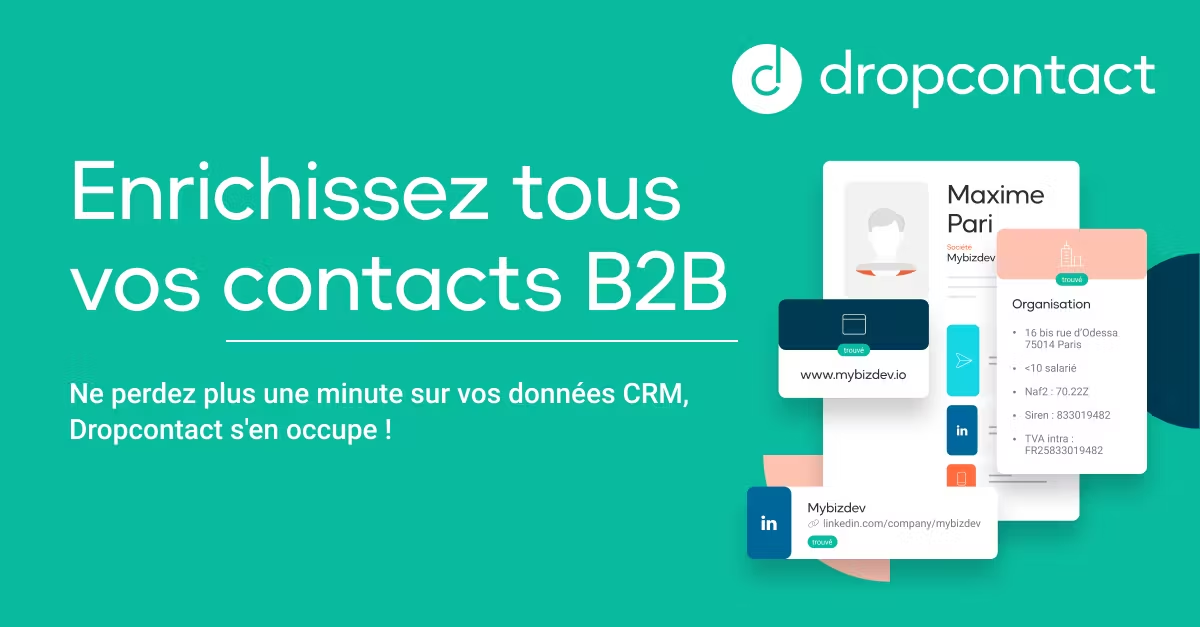
Dropcontact is a 100% French B2B enrichment tool, known for its strict GDPR compliance. It automatically verifies, corrects and enriches contacts (business email, name, job title, company) via API or CRM integration. Unlike others, it does not store any third-party database: everything is generated on the fly, which guarantees fresh, legal data.
Pros
100% GDPR compliant
Very high email validity rate
Smooth integration with HubSpot, Pipedrive, Salesforce, etc.
Cons
Does not provide phone numbers
Less complete on firmographic data
Price
€24/month for 500 credits
GDPR
✔️ Yes
3. Kaspr
Summary
Kaspr is a Chrome extension designed to enrich LinkedIn profiles in real time. It lets you retrieve business emails and, in some cases, phone numbers directly from LinkedIn Sales Navigator. Handy for SDRs prospecting quickly, but the approach raises questions about GDPR compliance, especially when enriching without explicit consent.
Pros
Unlimited emails for free
Easy-to-use extension
Access to mobile numbers
Cons
Unclear GDPR position (no transparency on sources)
Reliability varies by contact
Risk of LinkedIn blocking
Price
Free (emails), paid plans from $49
GDPR
Partially
4. Clearbit
Summary
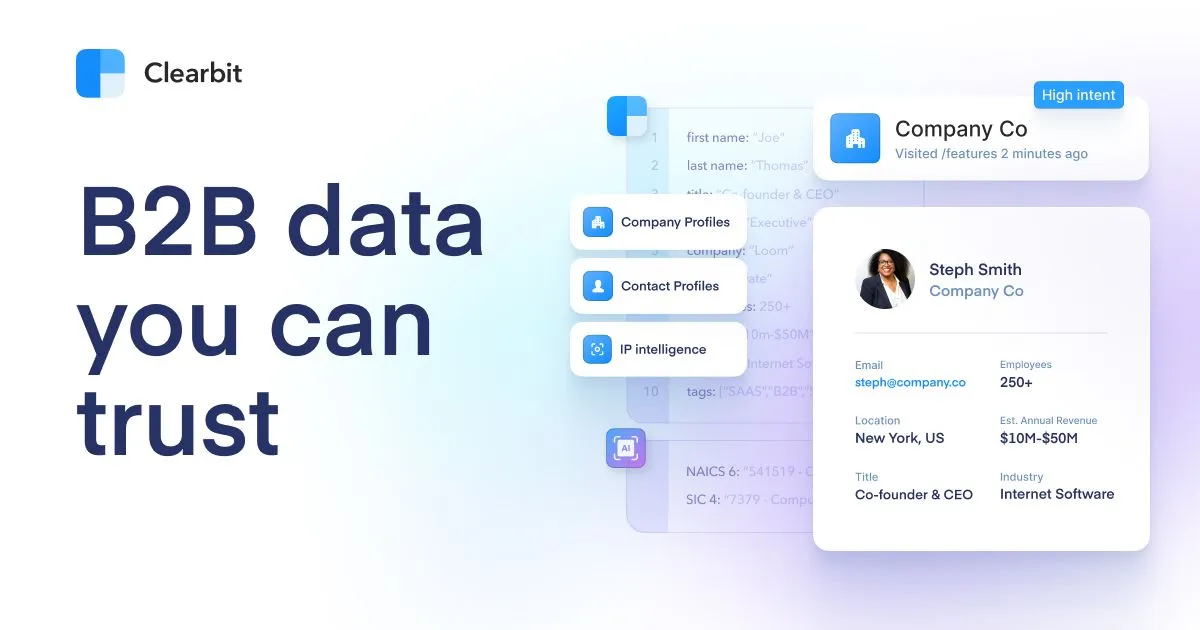
Clearbit is a benchmark for real-time enrichment, especially via API. The tool automatically fills in CRM or form fields (name, job title, company size, tech stack, etc.) as soon as a business email is entered. Very strong on the US market, it remains limited on GDPR and less reliable on European data. Ideal for tech and data-driven teams.
Pros
Real-time API
Detailed firmographic data
Solid CRM integrations
Cons
Data not hosted in Europe
High price
No guaranteed validated emails
Price
Custom quote
GDPR
❌ No
5. lemlist
Summary
lemlist is best known for multichannel prospecting (email, LinkedIn, cold calls) with strong personalization. Data enrichment is offered natively through built-in tools and waterfall enrichment. Useful for automatically enriching your contact list before sending a campaign and getting as many verified (and usable) email addresses as possible.
Pros
Prospecting + enrichment in one place
Good campaign personalization
LinkedIn integration and email sequences
Cons
Basic enrichment
Requires some sales expertise to get results
Price
$55 (Email Pro), $79 (Multichannel)
GDPR
✔️ Yes
6. FullEnrich
Summary
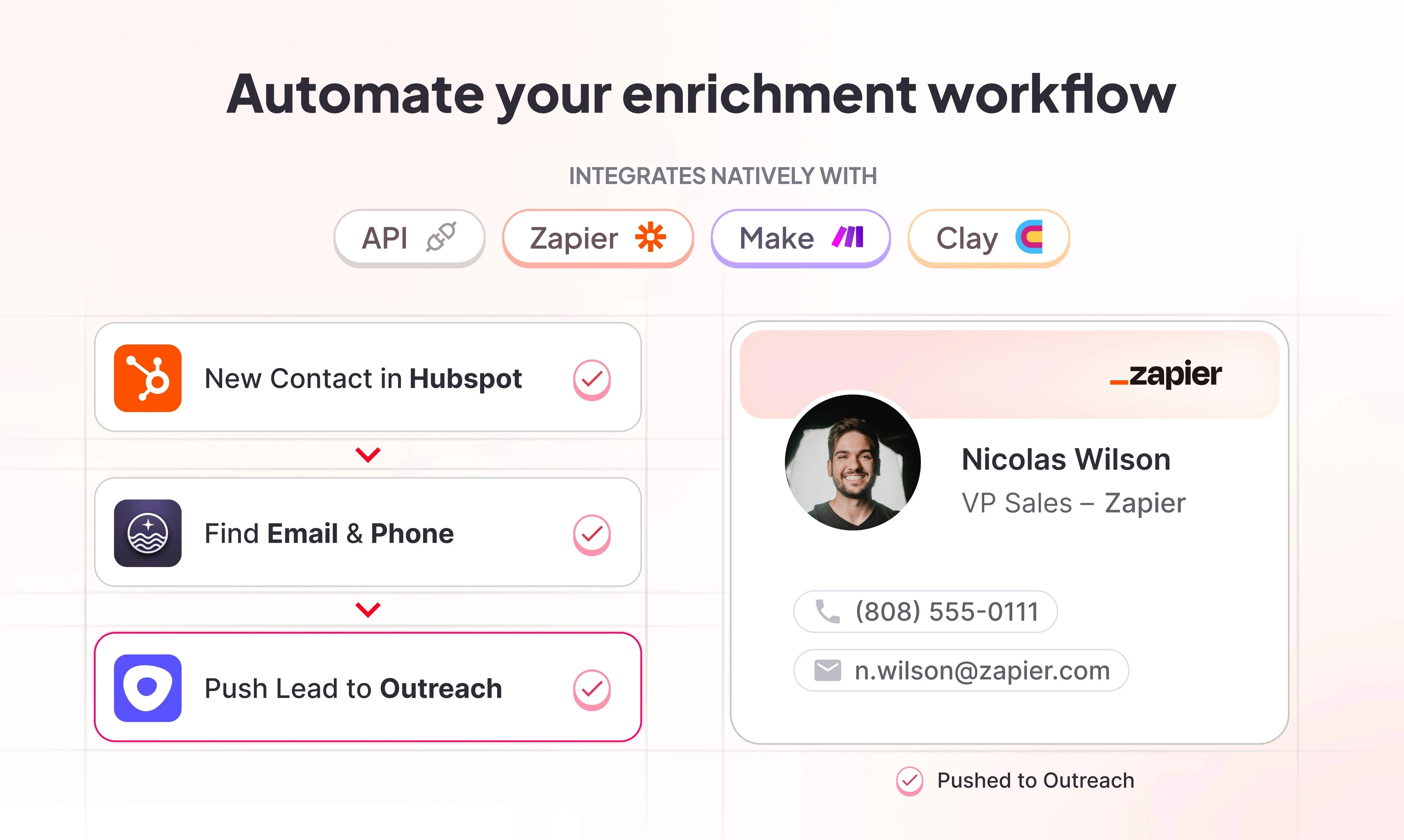
FullEnrich is a solution fully dedicated to waterfall enrichment, ideal for getting complete, reliable data. The tool queries several sources in parallel for each field (email, job title, phone) and applies cross-validation to limit errors. Very useful for teams that want to maximize lead quality without resorting to manual enrichment.
Pros
Vendor waterfall = high completion rate
Triple email verification
Easy-to-learn interface
Cons
Less documentation than the giants
Data sometimes skewed toward the US
Price
Starts at $29/month
GDPR
Yes
7. Apollo
Summary
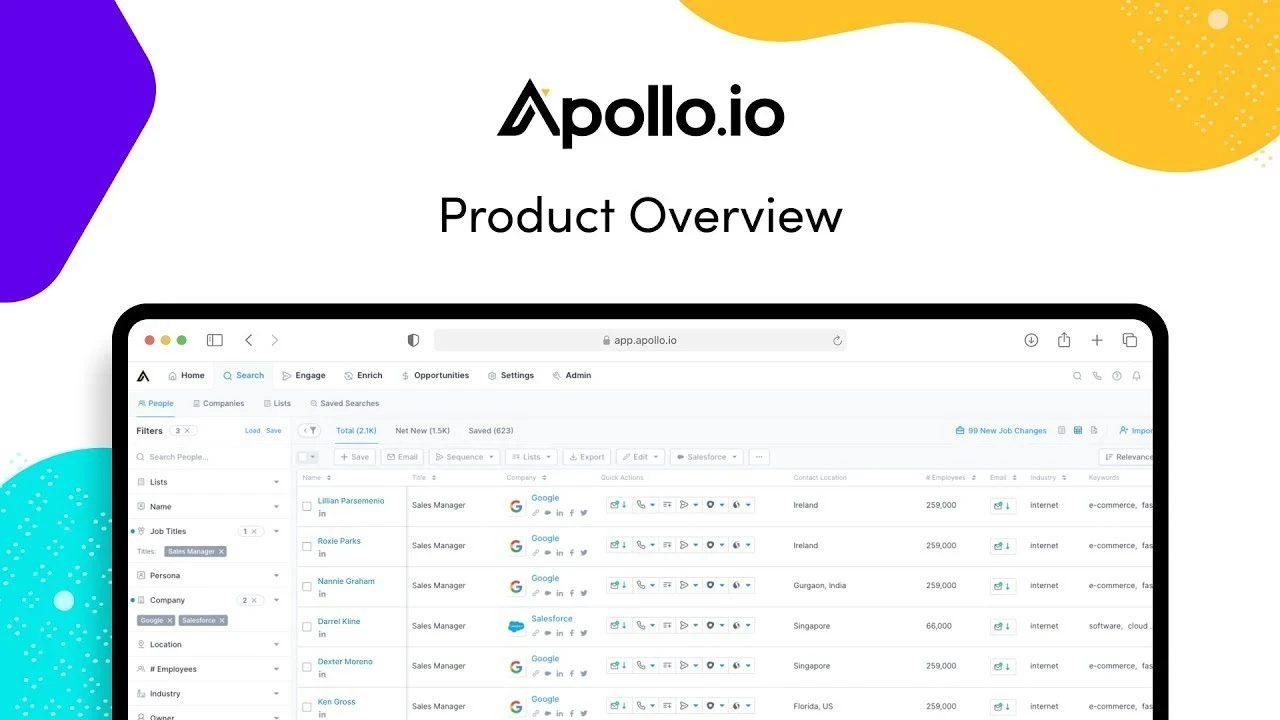
Apollo is a very popular all-in-one platform for B2B data enrichment. It combines a massive contact database with advanced filters (job title, tech stack, growth signals) and a Chrome extension to capture leads in real time. The tool also lets you launch prospecting sequences and manage your pipeline, which makes it a popular choice for startup Sales teams.
Pros
Waterfall-enriched data
Prospecting + built-in CRM
Emails and numbers included
Cons
Data quality sometimes uneven
Advanced features are paid
Price
Free, then from $49/month (with a free plan).
GDPR
✔️Yes
8. Cognism
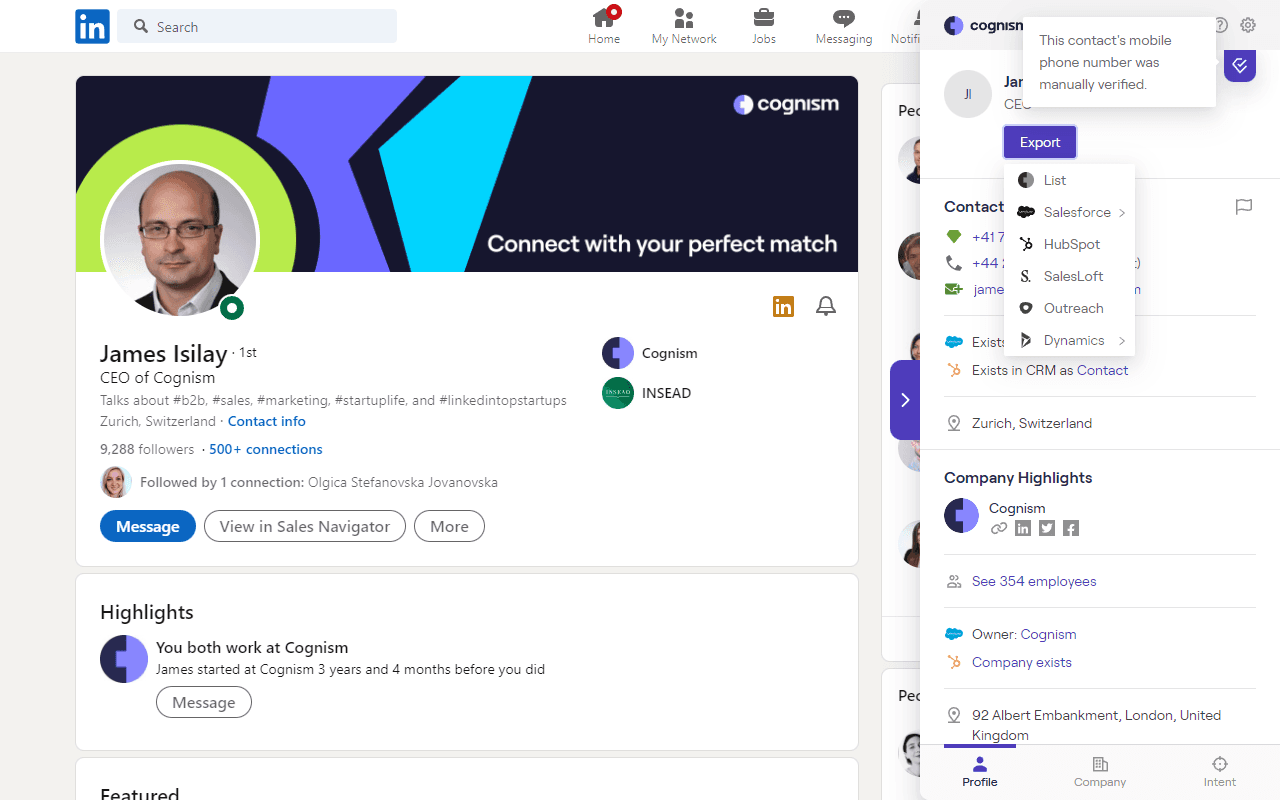
Summary
A high-end sales intelligence tool, especially strong on mobile numbers. Cognism is GDPR compliant and has a strong presence in Europe.
Pros
Strong mobile coverage
Verified data
Advanced CRM integrations
Cons
Reserved for companies with a large budget
Custom quote only
Price
Custom quote (often €15–30k/year)
GDPR
✔️ Yes
9. ZoomInfo
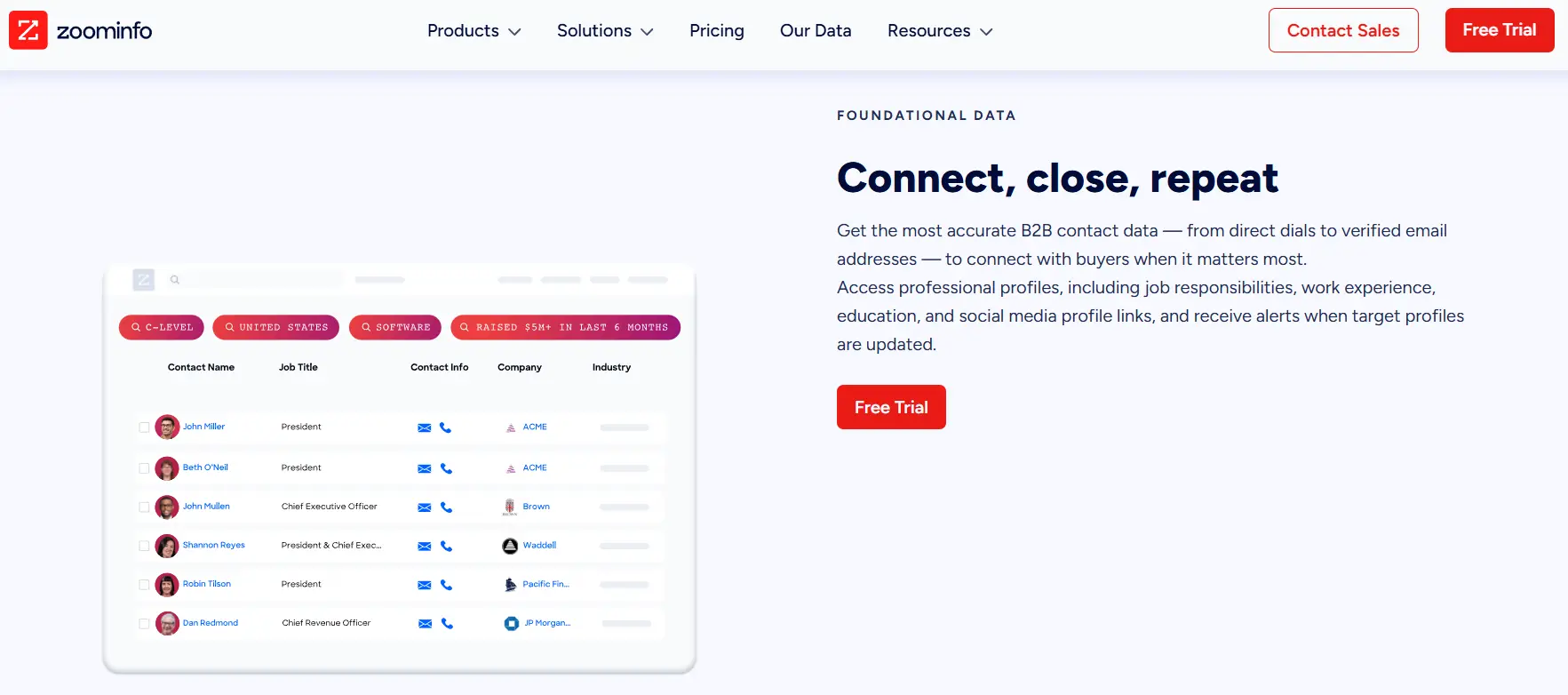
Summary
A must-have American tool for large-scale B2B Sales & Marketing teams. ZoomInfo offers a massive database, real-time insights, buying intent scores and advanced integrations (Salesforce, Outreach, HubSpot…). Very strong on the US market, but often less accurate in Europe.
Pros
Massive, continuously enriched database
Real-time insights
Complete SalesOps integration
Cons
Data often US-centric
High price
Data not always fresh
Price
From $15,000/year
GDPR
✔️Yes (to be checked depending on use)
10. Better Contact
Summary
A French solution specializing in dynamic B2B targeting. Better Contact identifies weak signals such as job changes, buying intent or the adoption of new technologies within a company. Ideal for triggering ultra-contextual campaigns, with a real activation logic rather than mass enrichment.

Pros
Actionable intent data
Advanced filters: stack, buying signals
Real-time alerts
Cons
Not designed for classic enrichment (email/phone)
Little visibility on pricing
Price
Custom quote
GDPR
✔️ Yes
FAQ: everything you need to know about B2B enrichment
Is data enrichment legal?
Yes, as long as you comply with GDPR. That means informing your contacts, allowing them to exercise their rights and using legitimate sources. In B2B, legitimate interest is often recognized, but you need to stay transparent.
Which enrichment method should you choose?
It all depends on your resources and goals. For an SMB without a dedicated team, automation or outsourcing (through Scalability, for example) is often more cost-effective.
If you have a very precise target, manual enrichment can make the difference. If you manage larger volumes of contacts, automated or waterfall enrichment saves time without sacrificing reliability.
Should you enrich a database only once?
No. B2B data ages fast: job changes, company changes, email address changes... Good enrichment is continuous, or at least quarterly.
What is the difference between "enrichment" and "scraping"?
Scraping means extracting publicly available data. Enrichment, on the other hand, completes existing data, often by cross-referencing sources. Neither is illegal, but the way you use them must be compliant.
Are all the tools on the market reliable?
No. Some promise the moon but recycle old databases or use questionable techniques. Always favor tools that are clear about where their data comes from and about their GDPR policy.
Conclusion
The best message sent to the wrong contact will get you nowhere. The right contact without context is wasted time.
But the right contact, at the right time, with the right information? That is where the magic happens.
B2B data enrichment does not "win" customers on its own. But it prepares the ground. It aligns your teams. It sharpens your campaigns. It turns your dormant files into live opportunities.
So whether you are an agile startup or a well-oiled sales team, ask yourself just one question:
Is your data really working for you? If the answer is no, you know where to start.
// Need help?
Outbound that books qualified meetings
Our experts and AI agents build and run your B2B prospecting.
// Key takeaways
32% of sales reps' time is wasted because of inaccurate or incomplete data.
Personalized emails convert 6 times more than generic emails.
Three methods: manual, waterfall or automated via API.
GDPR allows the use of B2B data if legitimate interest is demonstrated.
A B2B database ages fast: enrich continuously or at least every quarter.
Frequently asked questions
Is B2B data enrichment legal in France?
Yes, as long as you comply with GDPR. In B2B, legitimate interest is often recognized, but you must inform your contacts, allow them to exercise their rights and use legitimate sources. GDPR also requires you to guarantee the accuracy and origin of the data. So favor tools that are transparent about where their data comes from and about their compliance policy.
What is waterfall enrichment?
Waterfall enrichment combines several sources to cross-check, complete or validate data, for example one vendor for the email and LinkedIn for the job title. It offers broader coverage, a better completion rate and significant time savings. Its risks are inconsistencies between sources, duplicates and sometimes unclear traceability, which you need to watch to stay compliant.
What is the difference between enrichment and scraping?
Scraping means extracting publicly available data. Enrichment, on the other hand, completes data you already have, often by cross-referencing several sources. Neither practice is illegal in itself, but the way you use the data must remain GDPR compliant: informing people, using legitimate sources and respecting their rights.
How often should you enrich your contact database?
Once is not enough. B2B data ages fast: contacts change jobs, companies or email addresses. The guide recommends continuous enrichment, or at least quarterly. You can also pair it with email address verification (debounce) to have a ready-to-use contact list before each campaign.
Which enrichment method should an SMB choose?
It all depends on your resources and goals. For an SMB without a dedicated team, automation or outsourcing is often more cost-effective. If your target is very precise, manual enrichment can make the difference thanks to its accuracy. If you manage large volumes, automated or waterfall enrichment saves time without sacrificing reliability.