Leads and data
Everything You Need to Know About B2B Lead Capture (2026)
// Short answer
B2B lead capture covers the actions that collect contact details (name, email, phone) from visitors to your website or other channels, to turn an anonymous visitor into an identified contact. It relies on four levers: a precise ICP, a suitable lead magnet, smart automation (pop-ups, chatbots, email sequences), and contact enrichment followed by scoring.
By Benedicte Rivory
6 min read
Your website attracts visitors, but how many turn into genuinely interested contacts? You are not alone: 15% of marketers consider lead generation their main challenge. Lead capture is now more than a simple form: it is a strategic lever to build a predictable pipeline and ROI-driven lead management.
What is lead capture?
Lead capture is the set of actions put in place to collect the contact information (name, email, phone) of visitors to your website or other channels. The goal is to turn an anonymous visitor into an identified contact.
Traditional lead capture methods
For a long time, classic solutions paid off. But in a hypercompetitive market, they are showing their limits:
👉 Static forms : too long and without personalization, they scare people off more than they encourage them. Result: a high abandonment rate and few qualified leads.
👉 White papers and brochures : they help educate, but do not filter engagement. You collect email addresses, but with no certainty about real interest.
👉 Unoptimized live chat : it engages in real time, but requires a constant presence. For a small team, answering 24/7 quickly becomes time-consuming and costly.
Classic method | Advantage | Main limit |
|---|---|---|
Traditional form | Easy to deploy | Too generic, high bounce rate |
Free download | Attracts a wide audience | Hard to qualify interest |
Live chat | Immediate interaction | Human resources |
Modern methods to capture qualified leads
The key lies in an integrated lead capture strategy that orchestrates several levers:
✅ Personalized contextual pop-ups : triggered by browsing intent and behavior (scroll, time spent). They offer targeted content and drive action without interrupting.
✅ Enriched conversational chatbots : combined with fine segmentation, they ask pre-qualifying questions before starting a human conversation, so you only keep leads with a high probability of converting.
✅ Webinars and interactive demos : live or on demand, these formats build trust and position the brand as an expert. They generate more mature leads, ready to discuss budget and timing.
✅ Dynamic retargeting campaigns : thanks to the tracking pixel, send personalized messages (exclusive offer, customer case study) to people who abandoned a form or visited a key page.
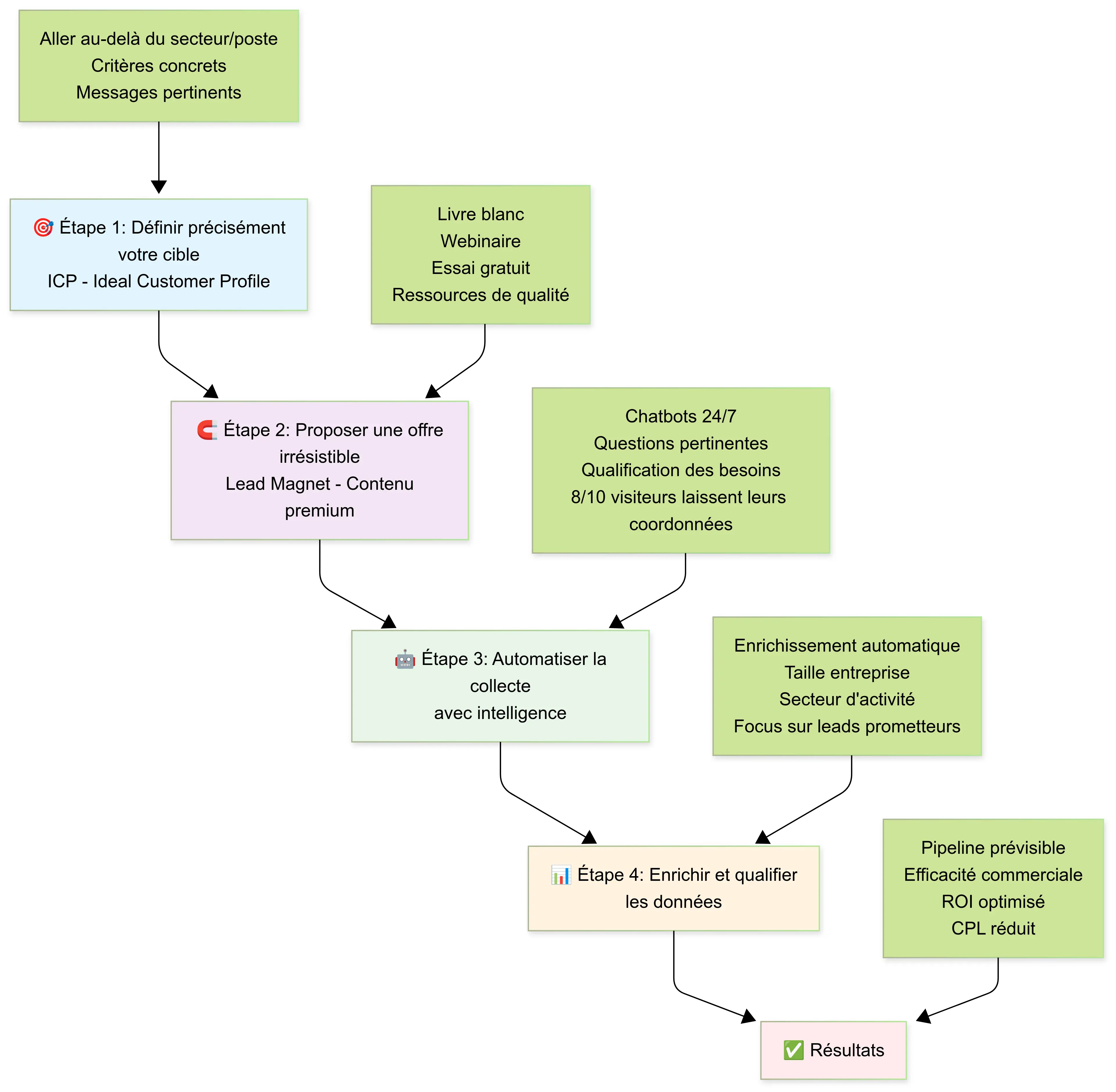
Example of a lead capture workflow:
The benefits of an optimized lead capture strategy
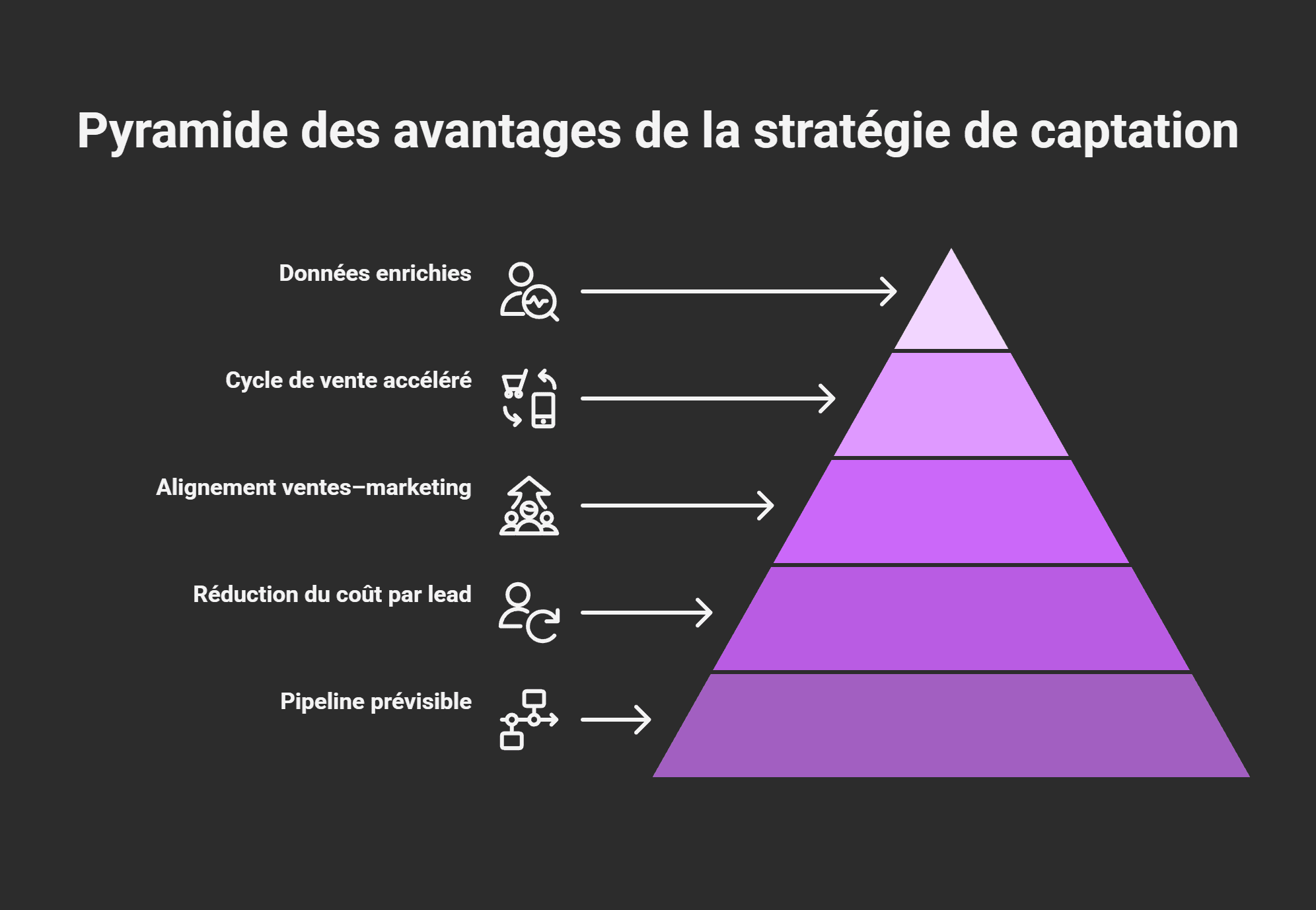
1. A predictable, scalable pipeline
Qualified leads come in regularly, limiting activity peaks and opportunity gaps.
2. Lower cost per lead
By focusing your efforts on mature prospects, you lower your CPL and improve your ROI.
3. Sales and marketing alignment
A clear ICP and precise scoring ensure that each team works on the same priorities.
4. A faster sales cycle
Prospects who are already informed and engaged move faster through the conversion funnel.
5. Enriched data for the future
You gain detailed customer knowledge, ready to feed your next campaigns or future products.
4 steps for effective lead capture
1. Target your ideal prospect (refined ICP)
Not all prospects are equal. Your Ideal Customer Profile (ICP) should include not only industry and job title, but also concrete criteria: company size, technologies used, digital maturity, top priorities. This ensures that each message truly "speaks" to your audience and maximizes your chances of capturing qualified leads.
2. Attract with an irresistible offer (tailored lead magnet)
A lead magnet is more than a simple free document. Offer:
A personalized practical guide (checklist, template)
An interactive webinar with live Q&A
A free trial or an exclusive demo
These formats offer real value and reveal your visitors' interests: downloading a template shows a different intent than a simple white paper.
3. Orchestrate smart automation
Automation should not mean "cold messages." Use:
Dynamic pop-ups : triggered by the visitor's journey (scroll, time on page)
Pre-qualifying chatbots : ask targeted questions before bringing in a human
Automated email sequences : enriched with conditional scenarios (opens, clicks)
You save time while capturing leads who are genuinely interested.
4. Enrich and score your contacts
Collecting an email is only the beginning. Automatically enrich your data:
Company size and industry
Job function and decision-making level
Interaction history (pages visited, content consumed)
Assign a score to each lead to prioritize follow-ups and ensure an optimal rate of qualified leads.
Mini-checklist before launching your lead capture program
[ ] Validated ICP : industry criteria, size, digital maturity, business challenges
[ ] Aligned lead magnet : guide, webinar or demo adapted to your audience's needs
[ ] Automation configured : contextual pop-ups, pre-qualification chatbot, conditional email sequences
[ ] Data enrichment workflow : collection of firmographic and behavioral information
[ ] Scoring defined : a clear prioritization grid for your sales teams
[ ] Performance tracking : dashboards to measure CPL, conversion rate and sales cycle
By checking these boxes, you make sure you deploy lead capture that is both effective and sustainable!
Conclusion and next steps
In summary, a high-performing lead capture strategy relies on:
A finely defined ICP to target the right prospects.
Tailored lead magnets that attract and reveal real interest.
Smart automation (pop-ups, chatbots, sequences) to engage without constant manual effort.
Contact enrichment and scoring to focus your resources on high-potential opportunities.
With these combined levers, you turn your web traffic into a flow of qualified leads, while optimizing your budget and your sales cycles.
FAQ
1. What is lead capture? Lead capture is the set of actions put in place to collect the contact information (name, email, phone) of visitors to your website or other channels. The goal is to turn an anonymous visitor into an identified contact.
2. How does a lead work? A lead works like a trail to follow. Once captured, it enters a qualification process (lead scoring) and a maturation process (lead nurturing) through personalized marketing actions.
3. What is lead capture software? Lead capture software is a tool that helps automate the collection of information about prospects. It can include features to create forms, landing pages, pop-ups and chatbots.
4. What does generating leads mean? Generating leads is the whole marketing process aimed at attracting strangers and converting them into identified contacts. Lead capture is a crucial step in this process. Scalability excels at B2B lead generation thanks to tailored strategies.
// Need help?
Outbound that books qualified meetings
Our experts and AI agents build and run your B2B prospecting.
// Key takeaways
15% of marketers see lead generation as their main challenge.
Static forms, white papers and live chat quickly show their limits.
Contextual pop-ups, chatbots, webinars and retargeting capture more mature leads.
4 steps: refined ICP, tailored lead magnet, automation, enrichment and scoring.
Benefits: a predictable pipeline, lower CPL, a faster sales cycle.
Frequently asked questions
What is the difference between lead capture and lead generation?
Lead generation refers to the whole marketing process that attracts strangers and converts them into identified contacts. Lead capture is one specific step of it: the moment you collect a visitor's contact details through a form, a pop-up, a chatbot or a webinar registration. Once captured, the lead then enters a scoring and nurturing process.
Why do my contact forms convert poorly?
Static forms are often too long and lack personalization, which leads to a high abandonment rate and few qualified leads. They are easy to deploy but too generic. This guide recommends contextual pop-ups triggered by behavior (scroll, time spent) and chatbots that ask a few pre-qualification questions before a human conversation.
Which lead magnet should you offer in B2B?
An effective lead magnet goes beyond a simple free document. This guide mentions a personalized practical guide (checklist, template), an interactive webinar with live Q&A, or a free trial and an exclusive demo. These formats bring real value and reveal the visitor's interest: downloading a template shows a different intent than a simple white paper.
What should you do with a lead once it is captured?
Collecting an email is only the beginning. Automatically enrich the contact with company size and industry, job function and decision-making level, and interaction history (pages visited, content consumed). Then assign it a score to prioritize sales follow-ups and focus your resources on high-potential opportunities.
What is lead capture software?
It is a tool that automates the collection of information about prospects. It can include the creation of forms, landing pages, pop-ups and chatbots. Combined with conditional email sequences and a dashboard, it lets you track cost per lead, conversion rate and sales cycle length.