Prospecting
How to Generate Leads on LinkedIn in 2026
// Short answer
To generate leads on LinkedIn in 2026, optimize your profile for conversion, regularly publish content that addresses your prospects' problems and target the right decision-makers with advanced search or Sales Navigator. Personalize every connection request, comment in a useful way, combine LinkedIn with email and phone, and react quickly to intent signals such as a job change.
By Benedicte Rivory
13 min read
LinkedIn has become a sales battlefield. Every day, thousands of messages, posts and invitations flood the news feed. The result: capturing the attention of a qualified decision-maker has never been harder.
Lead generation on LinkedIn is no longer about sending random connection requests. It requires a clear method to identify the right profiles, spark useful conversations and turn those exchanges into meetings.
With the right approach, LinkedIn can become a real machine to prospect on LinkedIn. An optimized profile, relevant content, targeted conversations: every action feeds a predictable, measurable sales pipeline.
And because a saturated market does not forgive improvisation, only a structured, well-equipped and disciplined strategy makes the difference. Lead generation on LinkedIn now relies on this winning combination.
What is lead generation on LinkedIn?
💡 Lead generation on LinkedIn means turning the platform into a sales lever.
In practice, it means identifying the right profiles, capturing their attention with relevant content, then creating personalized exchanges that pave the way for a business relationship. The goal is not to pile up connections, but to build a qualified, lasting pipeline.
Why bet on LinkedIn to generate leads in 2025?
LinkedIn is no longer just a professional social network, it has become an essential hunting ground for sales teams. Where cold calling plateaus with conversion rates rarely above 2%, LinkedIn lets you reach decision-makers directly, at the moment they are open to business opportunities.
LinkedIn is not just one more channel, it is now where the first decisive stages of the sales relationship play out.
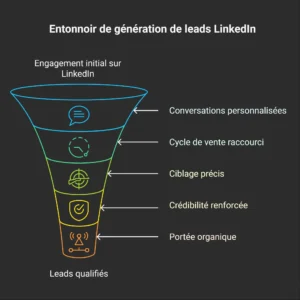
In practice, the platform offers several strategic levers.
1. More qualitative conversations
Each message can be personalized based on the prospect's background, role or shared content. The result: reply rates far higher than a cold email sent in bulk.
2. A shorter sales cycle
Prospects met on LinkedIn are often better informed and further along in their buying thinking, which reduces the time needed to close a deal.
3. Ultra-precise targeting
Advanced filters, Boolean search, enrichment tools: LinkedIn lets you aim at the right contacts without wasting time on unqualified leads.
4. Stronger credibility
Your LinkedIn profile and posts act as a showcase for your expertise. Even before you get in touch, the prospect may already be convinced of your legitimacy.
5. A multi-format channel
Posts, private messages, videos, polls... LinkedIn offers a variety of formats to engage a prospect at different stages of their journey.
6. Unique organic reach
Unlike other saturated channels, LinkedIn still offers significant organic visibility: a good post can reach thousands of decision-makers with no advertising budget.
9 strategies to generate leads on LinkedIn
Effective prospecting is never improvised. It relies on a clear method, repeated actions and disciplined execution. Here are ten concrete strategies to turn LinkedIn into a lasting acquisition channel.
1. Optimize your profile for conversion
Your profile is your digital business card. In a few seconds, a visitor must understand who you are, what you offer and why they should trust you. It is the foundation of a solid online reputation and a qualified pipeline.
Here are the elements to polish first:
→ A professional photo and an engaging banner: they should reflect your positioning and your added value.
→ A punchy headline: go beyond your job title by highlighting a concrete benefit for your clients.
→ A narrative, action-oriented "About" summary: tell your story, highlight your expertise and finish with a clear call to action (booking a meeting, downloading a guide, etc.).
→ Results-oriented experience: emphasize measurable impact (figures, savings, growth generated).
→ Recommendations and social proof: they strengthen your credibility and create instant trust.
👉 Example of an impactful headline: "I help SMBs cut their operating costs by 20%"
An optimized profile becomes more than a showcase: it is a conversion tool in its own right, able to trigger business conversations even before the first message.
2. Publish content that attracts your prospects
On LinkedIn, visibility is earned through the value you provide. To get more views, regularly publish content that addresses a concrete problem for your audience. Every post should demonstrate your expertise and spark interaction.
The algorithm favors posts from individuals over those from company pages, which gives personal profiles a clear advantage.
👉 To maximize impact, mix formats:
Short posts: a quick tip or a strong idea to grab attention.
Carousels: perfect for detailing a process or sharing a step-by-step method.
Videos: ideal for humanizing your message, telling a story or showing a practical case.
Polls: effective for starting a conversation and gathering insights directly from your prospects.
Case studies or testimonials: social proof remains one of the most powerful levers to build trust.
By publishing useful, consistent content, you create a virtuous circle. More views → more engagement → more qualified prospects in your pipeline.
3. Use advanced search to target your leads
Finding the right prospects is often the most time-consuming part of prospecting. With a free account, LinkedIn limits your searches to 1,000 results per month, which quickly narrows your targeting options.
This is where LinkedIn Sales Navigator becomes essential. The tool lifts this restriction and offers dozens of filters to refine your searches:
Function and seniority level (e.g. CEO, Head of Sales, Manager).
Company size and industry.
Precise geographic area.
Time in role or at the company.
Keywords in the profile.
And many more.
👉 A concrete example: you are a B2B agency targeting SaaS startups with fewer than 50 employees in Paris. With Sales Navigator, you can build a hyper-targeted list of "Head of Growth" or "CMO" contacts that match this profile exactly.
This "surgical" approach avoids wasting time on unqualified prospects and mechanically increases your reply rates. By building relevant lists from the start, you turn LinkedIn prospecting into a more predictable, more effective process.
4. Interact strategically
Posting regularly is not enough to have a real impact on LinkedIn. The algorithm also rewards engagement, and a relevant comment can sometimes generate more visibility than a regular post.
The goal is to make a useful contribution and demonstrate your expertise. Superficial reactions ("Interesting", "Thanks for sharing") have little value. On the other hand, a well-built contribution positions your profile as a credible reference.
A few best practices to apply:
✔️ Target the right people: comment first on posts from your prospects or from thought leaders your audience follows.
✔️ Add context to your comments: rely on figures, a customer experience or a concrete case to enrich the discussion.
✔️ Stimulate thinking: ask open questions that invite replies and extend the conversation.
✔️ Boost visibility: when relevant, mention a resource or an industry player to add extra value.
Example of a high-value comment: "We also see that this approach shortens the sales cycle. In our industry, putting educational content in place upstream cut the time to signature by 20%. Are you seeing a similar trend?"
Every interaction then becomes an opportunity to reinforce your expertise and nurture a professional relationship even before direct contact.
5. Personalize every connection request
A generic invitation sent without context is likely to be ignored, or even reported as unwanted. On the other hand, a personalized message significantly increases the acceptance rate and opens the way to a quality first interaction.
To capture your contact's attention, rely on concrete elements:
Reference an article, post, comment or talk published by your target.
Mention a mutual contact or a shared event (conference, webinar, network).
Highlight a shared professional interest or an industry challenge.
👉 Example: "Hi {{FirstName}}, I read your article on digitizing HR processes. A very relevant topic. I would be glad to discuss the solutions we are putting in place for similar organizations."
Every connection request should be treated as a first impression: polished, contextual and focused on creating value.
6. Multichannel prospecting
An effective B2B prospecting sequence never relies on a single channel. After a connection is accepted on LinkedIn, a follow-up email or a phone call can anchor your message and speed up meeting booking.
The numbers speak for themselves: more than 80% of sales require at least five touchpoints. Limiting yourself to LinkedIn therefore reduces your chances of closing. Ideally, combine at least two channels to increase reply and conversion rates.
A few best practices
Build sequences that include LinkedIn, email, phone and possibly SMS or WhatsApp.
Adapt the message to each channel (more direct by phone, more detailed by email, more conversational on LinkedIn).
Schedule your follow-ups over 2 to 3 weeks to stay present without being intrusive. Or even longer, depending on the nature of your offer.
7. Use LinkedIn events as a prospecting lever
Events and webinars hosted on LinkedIn are a particularly valuable source of leads. Attendees are already familiar with the topic, which makes them qualified contacts who are more receptive than cold targets. To maximize impact, it is essential to make the most of every stage of the event.
Before the event
Identify registrants and send them a personalized invitation, explaining your shared interest in the topic.
Share content related to the theme (article, study, infographic) to create a useful first touchpoint.
Position yourself as a credible player: comment on or share the event post to gain visibility with the audience.
During the event
Join the chat with relevant questions or thoughtful remarks. This helps you stand out and get noticed by organizers and attendees alike.
Note the most active speakers and attendees: they are often engaged prospects to target first.
After the event
Send a contextual connection request: mention that you both attended to create a natural link.
Follow up with a message that adds value, for example a summary of the event or a complementary resource.
Segment the list of registrants to prioritize your efforts: very active prospects, regular attendees, secondary contacts.
The list of registrants is a qualified database you can enrich and use. Combined with a structured approach, it becomes an excellent entry point to start targeted conversations and build a pipeline of warm leads.
8. Make social selling a team effort
Social selling becomes more effective when it is not limited to a single salesperson but carried by the whole team. Every team member can become a visibility relay and a source of trust for the brand.
The numbers speak for themselves: 88% of consumers trust recommendations from their peers more than advertising messages. By involving several profiles in your LinkedIn strategy, you multiply credible touchpoints with your prospects.
5 tips to roll out a team strategy
✔️ Optimize each individual profile: headlines, summaries and experience should reflect both the person's expertise and the company's overall offer. If possible, all share the same visual identity: format, logo, colors, etc. The team should be recognizable at a glance.
✔️ Launch an employee advocacy program: centralize and offer ready-to-use content that your team members can share easily.
✔️ Train teams in social selling: show how to comment, post or engage without slipping into a promotional tone. Harmonize best practices for better individual and collective results.
✔️ Showcase internal results: highlight high-visibility posts or meetings booked through LinkedIn to encourage participation.
✔️ Encourage diverse perspectives: team members can cover a range of topics (technical, business, management), which enriches the brand's overall presence.
A team social selling program does more than increase organic reach. It also strengthens the company's credibility, because your prospects see several experts with consistent messaging, not a single isolated voice.
10. Monitor and act on buying intent signals
Some behaviors on LinkedIn show that a prospect is ready to move forward. Spotting them lets you contact the right person at the right time.
4 signals not to miss
A job change or new responsibilities: often associated with a budget or new needs.
Repeated engagement with your content: likes, comments, shares = growing interest.
Immediate acceptance of a connection request: a sign of openness to discussion.
Increased activity on the network: posts, events, groups.
What next?
Set up alerts (e.g. Sales Navigator) to detect these signals.
Send a contextual message that refers to the trigger, always personalized and, if possible, written by hand!
Connect this data to your CRM to prioritize "hot" leads.
A prospect showing an intent signal rarely waits. Responsiveness is your best asset here.
The best tools for LinkedIn prospecting
Moving from a few one-off actions to prospecting at scale requires the right tools. The goal: automate repetitive tasks while keeping a personalized approach.
Tool category | Examples | Main strengths / Use cases |
|---|---|---|
Integrated multichannel prospecting | A complete solution that combines AI, automation and human expertise to manage the entire prospecting cycle: sourcing, enrichment, multichannel sequences (LinkedIn, email, phone, WhatsApp), follow-up and meeting booking. Ideal for industrializing prospecting while keeping personalization. | |
Advanced search and targeting | Precise prospect identification thanks to advanced filters: industry, company size, role, technologies used... Sales Navigator is the global benchmark, while Pharow stands out on the French market. | |
Enrichment and contact data | Adding or verifying emails and phone numbers. Dropcontact guarantees GDPR-compliant updates, Kaspr and Lusha make it easy to quickly retrieve contact details from LinkedIn, and Skrapp specializes in business emails. | |
Automation of sequences and repetitive tasks | Automation of LinkedIn actions (connection requests, follow-ups, profile visits) and simple multichannel sequences. It saves time, provided you configure it carefully to respect LinkedIn's limits. |
Scalability lets you turn LinkedIn into a real prospecting machine. By centralizing your data and combining AI, automation and human expertise, the platform helps you identify, engage and convert the right decision-makers faster.
"I launched my go-to-market using Scalability. Within 1 month I had signed my first 5 clients." Neil Azouz, CEO @Noticia
Conclusion
Lead generation on LinkedIn is not a one-off action but a discipline. It requires a well-crafted profile, content that demonstrates your expertise and multichannel prospecting carried out consistently. Together, these levers turn LinkedIn into a lasting growth engine that can steadily feed your sales pipeline.
That leaves the question of execution: how do you industrialize these actions without losing personalization? That is precisely Scalability's role. By combining AI, automation and human expertise, the platform centralizes your data, orchestrates your campaigns and lets you spend more time on what matters most: your relationship with your prospects.
// Need help?
Outbound that books qualified meetings
Our experts and AI agents build and run your B2B prospecting.
// Key takeaways
A free account limits LinkedIn search to 1,000 results per month.
The algorithm favors posts from individual profiles over company pages.
More than 80% of sales require at least five touchpoints.
88% of consumers trust peer recommendations more than advertising.
Job changes and repeated engagement are intent signals to watch.
Frequently asked questions
How do you optimize your LinkedIn profile to generate leads?
Use a professional photo and a banner that reflect your positioning. Write a headline that highlights a client benefit rather than just your job title, for example helping SMBs cut their costs. Write a narrative summary that ends with a call to action, describe results-oriented experience and add recommendations as social proof.
Do you need to pay for LinkedIn Sales Navigator to prospect?
With a free account, LinkedIn limits your searches to 1,000 results per month, which quickly narrows your targeting options. Sales Navigator lifts this restriction and adds dozens of filters: function, seniority level, company size and industry, geographic area, time in role, keywords. It also lets you set up alerts to spot buying intent signals.
How do you personalize a LinkedIn connection request?
A generic invitation is likely to be ignored, or even reported as unwanted. Rely on a concrete element: an article, post or comment published by your target, a mutual contact, a shared event such as a conference or webinar, or a common industry challenge. Treat each request as a polished, contextual first impression focused on value.
How do you use LinkedIn events to prospect?
Before the event, invite registrants with a personalized message and share content on the topic. During the event, join the chat with relevant questions and spot the most active attendees. Afterward, send a connection request that mentions you both attended, follow up with a useful resource and segment registrants to prioritize your efforts.
Which signals show that a LinkedIn prospect is ready to buy?
The guide lists four signals: a job change or new responsibilities, often linked to a budget or new needs; repeated engagement with your content; immediate acceptance of a connection request; increased activity on the network. Set up alerts, send a message that mentions the trigger and connect this data to your CRM.